
The phrase “first come, first served” is one of the most common English expressions. It means that people who arrive or apply earlier receive service, access, or opportunities before those who come later.
Although this phrase is easy to understand, it is not always the best choice. In professional emails, customer announcements, business policies, or academic writing, a different expression may sound clearer, more polite, or more formal.
Using the right alternative also helps you match your tone to the situation. A friendly social media post may need casual wording, while a company policy or workplace email often benefits from more professional language.
For example:
- Formal: Applications will be processed in the order they are received.
- Informal: Get here early before the spots are gone!
Learning different ways to express the same idea makes your English more natural, flexible, and confident in everyday conversations, business communication, and professional writing.
What Does “First Come, First Served” Mean?
First come, first served means that people receive something based on the order in which they arrive, register, apply, or request it. The earliest person gets served first, followed by everyone else in the same order.
Grammar Form:
It is an idiomatic phrase commonly used as an adjective or as part of a sentence explaining a rule or policy.
Similar Expressions
- In order of arrival
- Served by arrival time
- Processed in order received
- Earliest applicants first
Opposite Ideas
- Random selection
- Lottery system
- Priority access
- Invitation only
Examples
- Tickets are available on a first come, first served basis.
- Parking spaces are first come, first served, so arrive early.
When to Use “First Come, First Served”
Spoken English
This phrase works well when explaining simple rules in everyday conversation.
Example:
“Seats are first come, first served.”
Business English
Businesses often use the phrase when offering limited products, appointments, or registrations.
Example:
“The promotion is available on a first come, first served basis.”
Emails and Messages
It helps explain availability clearly when there are limited spaces.
Example:
“Workshop seats will be allocated on a first come, first served basis.”
Social Media
It creates urgency and encourages quick action.
Example:
“Only 20 spots left—first come, first served!”
Academic Writing
In formal documents, a more professional alternative often sounds better.
Example:
“Applications will be processed in the order received.”
Professional Meetings
Managers may use it when discussing scheduling or resource allocation.
Example:
“Meeting rooms will be assigned according to reservation time.”
Is “First Come, First Served” Polite or Professional?
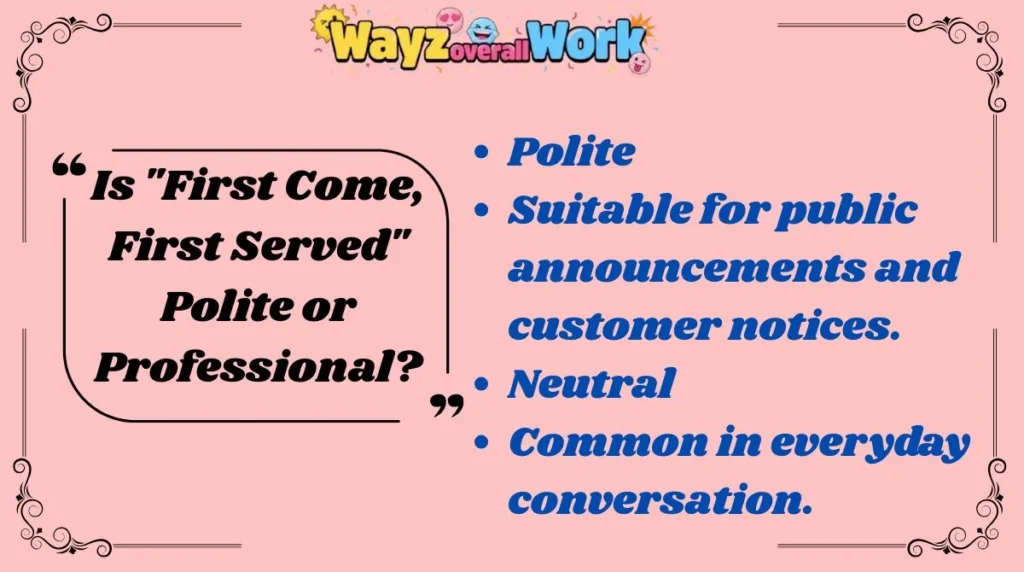
The phrase is generally polite and widely accepted. However, its tone depends on the setting.
Polite
Suitable for public announcements and customer notices.
Neutral
Common in everyday conversation.
Strong
Can sound strict when emphasizing limited availability.
Soft
A softer version explains the process rather than simply stating the rule.
Formal vs. Informal
It is acceptable in formal writing but can sound more polished when replaced with expressions like “processed in the order received.”
Etiquette Tip:
For corporate emails, government notices, and professional documents, choose a more formal alternative whenever possible.
Pros & Cons of Using “First Come, First Served”
✔ Pros
- Easy to understand
- Common in everyday English
- Works in many situations
- Clearly explains fairness
- Suitable for announcements
✘ Cons
- Sounds repetitive when overused
- Can seem informal in business documents
- May feel too direct in customer service
- Better alternatives exist for professional writing
- Not always ideal for academic English
Quick Alternatives List
- In the order received
- In order of arrival
- Allocated by registration time
- Served according to arrival
- Processed in sequence
- Early applicants receive priority
- Available until capacity is reached
- Issued in the order requests are received
- Handled chronologically
- Priority goes to early applicants
- Reservations are honored by booking time
- Based on submission order
- Assigned in arrival order
- Distributed while supplies last
- Offered to the earliest registrants
- Processed on a rolling basis
- Given to those who register first
- Accepted until all places are filled
In the Order Received
Meaning:
Requests are handled according to when they arrive.
Explanation:
This is one of the most professional alternatives. It is common in business communication and official notices.
Grammar Note:
Formal prepositional phrase.
Example Sentence:
Applications will be reviewed in the order received.
Best Use:
Formal, Email, Workplace
Worst Use:
Casual conversations among friends.
Tone:
Professional
Level:
Beginner
Similarity Score: 10/10
Replaceability Tip:
Choose this when writing business emails or official announcements.
In Order of Arrival
Meaning:
People are served based on arrival time.
Explanation:
This phrase is clear and easy for both native and non-native speakers.
Grammar Note:
Prepositional phrase.
Example Sentence:
Guests will be seated in order of arrival.
Best Use:
Formal, Workplace
Worst Use:
Social media marketing.
Tone:
Neutral
Level:
Beginner
Similarity Score: 10/10
Replaceability Tip:
Perfect for events and waiting lines.
Processed in Sequence
Meaning:
Items are handled one after another.
Explanation:
Common in administrative and technical writing.
Grammar Note:
Formal phrase.
Example Sentence:
Requests are processed in sequence.
Best Use:
Professional
Worst Use:
Friendly conversations.
Tone:
Formal
Level:
Intermediate
Similarity Score: 9/10
Replaceability Tip:
Ideal for office policies.
Handled Chronologically
Meaning:
Items are managed according to time order.
Explanation:
A polished choice for reports and official documents.
Grammar Note:
Formal phrase.
Example Sentence:
Cases are handled chronologically.
Best Use:
Academic, Workplace
Worst Use:
Text messages.
Tone:
Professional
Level:
Advanced
Similarity Score: 8/10
Replaceability Tip:
Use when discussing records or documents.
Priority Goes to Early Applicants
Meaning:
People who apply first receive preference.
Explanation:
This wording sounds encouraging instead of strict.
Grammar Note:
Complete sentence.
Example Sentence:
Priority goes to early applicants.
Best Use:
Emails, Admissions
Worst Use:
Queues at stores.
Tone:
Friendly
Level:
Beginner
Similarity Score: 8/10
Replaceability Tip:
Great for scholarships and job applications.
Early Applicants Receive Priority
Meaning:
Those who apply early are considered first.
Explanation:
Very common in universities and recruitment.
Grammar Note:
Complete statement.
Example Sentence:
Early applicants receive priority during review.
Best Use:
Professional
Worst Use:
Restaurant seating.
Tone:
Professional
Level:
Intermediate
Similarity Score: 8/10
Replaceability Tip:
Excellent for hiring and admissions.
Allocated by Registration Time
Meaning:
Places are assigned according to registration.
Explanation:
Frequently used for events and workshops.
Grammar Note:
Passive phrase.
Example Sentence:
Seats are allocated by registration time.
Best Use:
Events
Worst Use:
Daily conversation.
Tone:
Formal
Level:
Intermediate
Similarity Score: 9/10
Replaceability Tip:
Perfect for conferences.
Based on Submission Order
Meaning:
Requests are considered in the order submitted.
Explanation:
A natural business alternative.
Grammar Note:
Prepositional phrase.
Example Sentence:
Reviews are completed based on submission order.
Best Use:
Professional
Worst Use:
Casual speech.
Tone:
Professional
Level:
Intermediate
Similarity Score: 9/10
Replaceability Tip:
Ideal for online forms.
Served According to Arrival
Meaning:
Service depends on arrival time.
Explanation:
A direct and simple alternative.
Grammar Note:
Passive phrase.
Example Sentence:
Customers are served according to arrival.
Best Use:
Retail
Worst Use:
Academic writing.
Tone:
Neutral
Level:
Beginner
Similarity Score: 9/10
Replaceability Tip:
Useful in customer service.
Reservations Are Honored by Booking Time
Meaning:
Bookings are respected according to reservation order.
Explanation:
Common in hospitality.
Grammar Note:
Complete sentence.
Example Sentence:
Reservations are honored by booking time.
Best Use:
Hotels, Restaurants
Worst Use:
Job applications.
Tone:
Professional
Level:
Intermediate
Similarity Score: 7/10
Replaceability Tip:
Best for reservation systems.
Processed on a Rolling Basis
Meaning:
Applications are reviewed continuously.
Explanation:
Unlike strict first come, first served, reviews happen as submissions arrive.
Grammar Note:
Formal phrase.
Example Sentence:
Applications are processed on a rolling basis.
Best Use:
Admissions
Worst Use:
Queues.
Tone:
Professional
Level:
Advanced
Similarity Score: 7/10
Replaceability Tip:
Ideal for universities and hiring.
Distributed While Supplies Last
Meaning:
Items remain available until none are left.
Explanation:
Common in advertising.
Grammar Note:
Promotional phrase.
Example Sentence:
Free gifts are distributed while supplies last.
Best Use:
Marketing
Worst Use:
Formal reports.
Tone:
Friendly
Level:
Beginner
Similarity Score: 6/10
Replaceability Tip:
Best for product promotions.
Given to Those Who Register First
Meaning:
Early registration receives priority.
Explanation:
Simple and easy for learners.
Grammar Note:
Passive phrase.
Example Sentence:
Discounts are given to those who register first.
Best Use:
Events
Worst Use:
Government documents.
Tone:
Neutral
Level:
Beginner
Similarity Score: 9/10
Replaceability Tip:
Excellent for workshops.
Assigned in Arrival Order
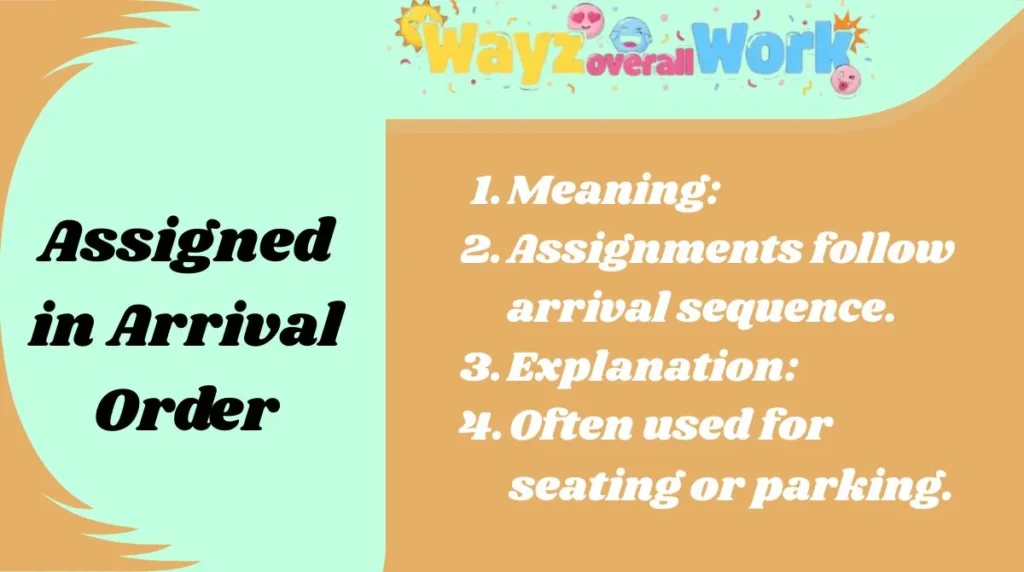
Meaning:
Assignments follow arrival sequence.
Explanation:
Often used for seating or parking.
Grammar Note:
Passive phrase.
Example Sentence:
Parking spaces are assigned in arrival order.
Best Use:
Facilities
Worst Use:
Casual chat.
Tone:
Professional
Level:
Intermediate
Similarity Score: 9/10
Replaceability Tip:
Useful in logistics.
Offered to the Earliest Registrants
Meaning:
People who register first receive the opportunity.
Explanation:
A polished promotional phrase.
Grammar Note:
Passive phrase.
Example Sentence:
Scholarships are offered to the earliest registrants.
Best Use:
Education
Worst Use:
Everyday speech.
Tone:
Professional
Level:
Advanced
Similarity Score: 8/10
Replaceability Tip:
Works well in formal announcements.
Accepted Until All Places Are Filled
Meaning:
Applications continue until capacity is reached.
Explanation:
This focuses on availability instead of order.
Grammar Note:
Passive construction.
Example Sentence:
Registrations are accepted until all places are filled.
Best Use:
Events
Worst Use:
Waiting lines.
Tone:
Neutral
Level:
Beginner
Similarity Score: 6/10
Replaceability Tip:
Use when capacity matters more than strict order.
Mini Dialogue Examples
Formal Conversation
Manager: How will registrations be handled?
Coordinator: Applications will be processed in the order received.
Informal Conversation
Alex: Are there still seats?
Jamie: Yes, but it’s first come, first served, so don’t be late.
Business Email Example
Subject: Workshop Registration
Seats are limited. Registrations will be accepted in the order received until capacity is reached.
Thank you.
Mistakes to Avoid
- Using first come first serve instead of first come, first served.
- Forgetting the comma in formal writing.
- Using it when a lottery or random selection is actually used.
- Choosing it in highly formal legal documents where a clearer phrase is preferred.
- Confusing it with “priority service.”
- Using promotional alternatives in academic papers.
- Repeating the same phrase too often in one article.
Cultural & Tone Tips
In both American and British English, first come, first served is a familiar and natural expression. Native speakers immediately understand it.
In US English, it commonly appears in advertisements, events, stores, and promotional offers.
In UK English, it is also widely used, although official organizations may prefer phrases like in the order received.
In casual conversations and social media, people often shorten the message by saying, “Get here early!” or “Don’t miss out!” instead of using the full phrase.
Comparison Table
| Phrase | Tone | Best Context | Professional Level | Example |
|---|---|---|---|---|
| In the order received | Professional | Emails | High | Applications are processed in the order received. |
| In order of arrival | Neutral | Events | High | Guests will be seated in order of arrival. |
| Priority goes to early applicants | Friendly | Admissions | Medium | Priority goes to early applicants. |
| Processed in sequence | Formal | Office | High | Requests are processed in sequence. |
| Allocated by registration time | Professional | Conferences | High | Seats are allocated by registration time. |
| Based on submission order | Professional | Online forms | High | Files are reviewed based on submission order. |
| Given to those who register first | Neutral | Workshops | Medium | Discounts are given to those who register first. |
FAQ
Is “first come, first served” rude?
No. It is generally polite and neutral.
Is it okay in emails?
Yes, but professional emails often sound better with in the order received.
What is the most formal alternative?
In the order received is one of the most formal choices.
What is the most polite alternative?
Priority goes to early applicants sounds friendly and polite.
Which alternative is easiest for beginners?
In order of arrival is simple and easy to understand.
Which alternative is best for business writing?
Applications will be processed in the order received is an excellent professional choice.
Conclusion
Learning different ways to say “first come, first served” helps you communicate more naturally in every situation.
While the original phrase is clear and widely understood, professional alternatives like “in the order received” or “processed in sequence” can make your writing sound more polished.
Casual options work well in conversations and social media, while formal expressions fit business emails, workplace announcements, and academic writing.
By practicing these alternatives in real conversations and written communication, you will improve your English fluency, expand your vocabulary, and choose the right tone with greater confidence.

Rashmeer is a passionate writer and content creator dedicated to delivering clear, engaging, and reliable information. With a focus on quality and authenticity, Rashmeer creates content that informs, inspires, and helps readers discover practical ideas and fresh perspectives.