
“How are you doing?” is one of the most common greetings in English. People use it to ask about someone’s health, mood, or overall well-being. You can hear it at work, in school, during phone calls, or while chatting with friends.
Although this phrase is friendly and natural, using the same greeting every day can sound repetitive. Learning different ways to say “How are you doing?” helps you sound more fluent, confident, and natural.
It also lets you match your words to the situation. Some expressions are better for business meetings, while others fit casual conversations or text messages.
Choosing the right greeting improves your communication. It shows respect, builds stronger relationships, and creates the right first impression.
Example:
Formal: How have you been?
Informal: What’s up?
The meaning is similar, but the tone is very different.
What Does “How Are You Doing?” Mean?
“How are you doing?” is a common English greeting that asks about another person’s condition, feelings, or current situation. In many conversations, it is simply a polite way to say hello rather than a request for detailed information.
Grammar Form
- Greeting phrase
- Question
- Common conversational expression
Similar Expressions
- How are you?
- How have you been?
- How’s everything?
- How’s it going?
- How are things?
Opposite Tone
Instead of asking about someone, opposite expressions often end or avoid conversation, such as:
- Goodbye.
- See you later.
- Take care.
Example Sentences
- Hi, Sarah. How are you doing today?
- Good morning! How are you doing after your trip?
When to Use “How Are You Doing?”
Spoken English
This phrase works naturally in everyday conversations with friends, neighbors, classmates, and people you meet regularly.
Example:
“Hey, Tom! How are you doing?”
Business English
It is acceptable in relaxed workplaces, especially before discussing business matters. However, formal meetings may require more professional greetings.
Example:
“Good morning, James. How are you doing today?”
Emails and Messages
Use it when writing to someone you already know. For first-time professional emails, choose a more formal opening.
Example:
“Hi Emma, I hope you’re doing well.”
Social Media
This greeting fits comments, private messages, and casual online conversations.
Example:
“Hey! How are you doing these days?”
Academic Writing
Avoid using “How are you doing?” in essays, research papers, and formal assignments because it is conversational rather than academic.
Instead, use professional language suitable for academic writing.
Professional Meetings
The phrase works during friendly meetings with colleagues or clients you already know. In formal presentations, more polished greetings sound better.
Example:
“Good afternoon. I hope everyone is doing well.”
Is “How Are You Doing?” Polite or Professional?
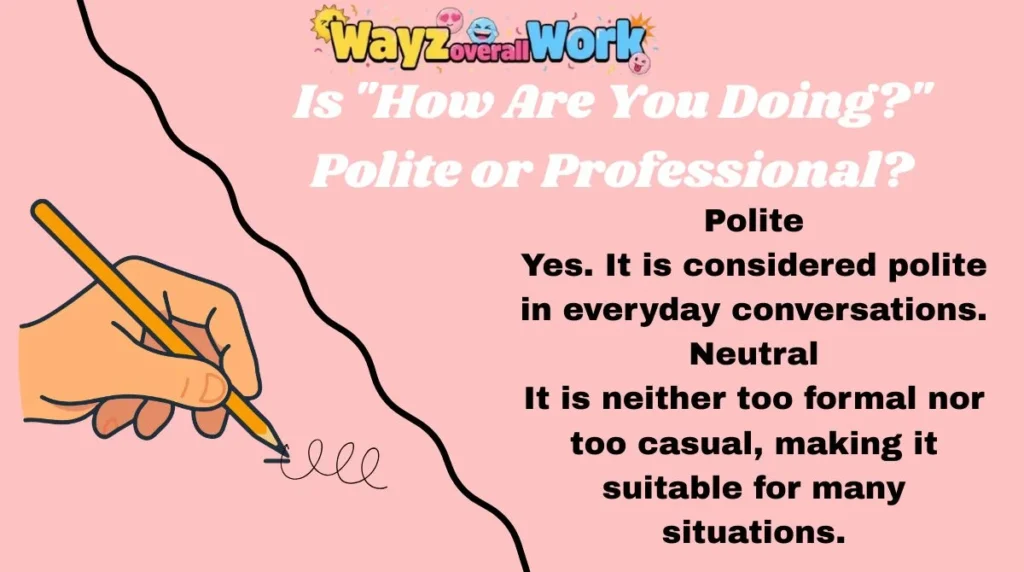
The answer depends on the situation.
Polite
Yes. It is considered polite in everyday conversations.
Neutral
It is neither too formal nor too casual, making it suitable for many situations.
Soft
The phrase sounds warm, friendly, and welcoming.
Strong
It is not a strong expression. It does not sound demanding or emotional.
Formal vs. Informal
- Formal: Acceptable but not the best choice for official communication.
- Informal: Very common and natural among friends, coworkers, and family.
Etiquette Tip: For business emails or corporate communication, “I hope you’re doing well” usually sounds more professional than “How are you doing?”
Pros & Cons of Using “How Are You Doing?”
✔ Pros
- Easy for beginners to learn.
- Friendly and polite.
- Works in many everyday situations.
- Helps start conversations naturally.
- Common in American and British English.
✘ Cons
- Can become repetitive.
- Slightly casual for formal business writing.
- Less suitable for academic communication.
- Native speakers often prefer more varied greetings.
- May sound routine if used too often.
Quick Alternatives List
If you need a fast replacement, try one of these:
- How are you?
- How have you been?
- How’s everything?
- How’s it going?
- How are things?
- What’s up?
- What’s new?
- How’s life?
- How have things been?
- How’s your day going?
- Hope you’re doing well.
- I hope all is well.
- How are things going?
- How’s everything going?
- How are you feeling?
- How have you been doing?
- Everything going well?
- How’s work going?
- How are things with you?
- How’s your week been?
How Are You?
Phrase
How are you?
Meaning
A simple greeting that asks about someone’s well-being.
Explanation
This is the most common alternative. It is suitable almost everywhere and sounds polite without being too formal. It is often used when meeting someone in person or starting a conversation.
Grammar Note
Greeting question.
Example Sentence
Good morning, Lisa. How are you today?
Best Use
Formal, informal, workplace, school, everyday conversations.
Worst Use
Not ideal if you want to sound unique or highly professional in writing.
Tone
Neutral
Level
Beginner
Similarity Score
10/10
Replaceability Tip
Choose this when you want a simple greeting that everyone understands.
How Have You Been?
Phrase
How have you been?
Meaning
Asks about someone’s recent life since your last meeting.
Explanation
Native speakers often use this greeting after not seeing someone for days, weeks, or even years. It shows genuine interest rather than being just a casual hello.
Grammar Note
Present perfect question.
Example Sentence
It’s great to see you again! How have you been?
Best Use
Friends, family, colleagues, reunions.
Worst Use
Avoid if you just saw the person earlier the same day.
Tone
Friendly
Level
Beginner
Similarity Score
9.5/10
Replaceability Tip
Use it whenever some time has passed since your last conversation.
How’s It Going?
Phrase
How’s it going?
Meaning
A casual way to ask how someone is doing.
Explanation
This expression is common in everyday English. Native speakers use it with friends, classmates, coworkers, and neighbors. It sounds relaxed and conversational.
Grammar Note
Informal greeting.
Example Sentence
Hey, Jake! How’s it going?
Best Use
Friends, coworkers, text messages, casual chats.
Worst Use
Formal reports or business emails.
Tone
Friendly
Level
Beginner
Similarity Score
9/10
Replaceability Tip
Choose this for relaxed conversations instead of repeating “How are you doing?”
How’s Everything?
Phrase
How’s everything?
Meaning
Asks about all parts of someone’s life or current situation.
Explanation
This greeting feels slightly warmer than “How are you?” because it includes work, family, studies, and life in general.
Grammar Note
Greeting phrase.
Example Sentence
Hi, Maria! How’s everything?
Best Use
Friends, relatives, coworkers.
Worst Use
Formal academic communication.
Tone
Warm
Level
Beginner
Similarity Score
9/10
Replaceability Tip
Use it when you want to sound more caring.
How Are Things?
Phrase
How are things?
Meaning
Asks how life or work is going.
Explanation
This expression focuses on someone’s overall situation rather than just their feelings. It works well in both personal and professional conversations.
Grammar Note
Greeting question.
Example Sentence
Hello, David. How are things at your new job?
Best Use
Workplace, family, friends.
Worst Use
Formal essays.
Tone
Neutral
Level
Intermediate
Similarity Score
8.8/10
Replaceability Tip
Use it when asking about someone’s general life or work.
Hope You’re Doing Well
Phrase
Hope you’re doing well.
Meaning
A polite expression showing goodwill before beginning a conversation.
Explanation
This is one of the most popular greetings in professional emails. It sounds respectful without being overly formal.
Grammar Note
Greeting statement.
Example Sentence
Hi Alex, I hope you’re doing well. I’m writing about tomorrow’s meeting.
Best Use
Emails, workplace, professional messages.
Worst Use
Very casual chats with close friends.
Tone
Professional
Level
Intermediate
Similarity Score
8.5/10
Replaceability Tip
Use this instead of “How are you doing?” in business emails.
I Hope All Is Well
Phrase
I hope all is well.
Meaning
A formal way to wish someone well.
Explanation
This greeting is common in business correspondence and professional communication. It sounds polished and respectful.
Grammar Note
Formal greeting statement.
Example Sentence
Dear Mr. Wilson, I hope all is well.
Best Use
Business emails, clients, professional letters.
Worst Use
Casual text messages.
Tone
Formal
Level
Intermediate
Similarity Score
8/10
Replaceability Tip
Choose this for formal written communication.
What’s Up?
Phrase
What’s up?
Meaning
A very casual greeting asking what someone is doing.
Explanation
Native speakers usually use this expression with close friends. Most of the time, people answer briefly rather than explaining everything.
Grammar Note
Informal slang greeting.
Example Sentence
Hey! What’s up?
Best Use
Friends, texting, social media.
Worst Use
Professional meetings, interviews, business emails.
Tone
Very Informal
Level
Beginner
Similarity Score
7.5/10
Replaceability Tip
Use it only when the conversation is relaxed and friendly.
What’s New?
Phrase
What’s new?
Meaning
A friendly way to ask if anything interesting has happened recently.
Explanation
Native speakers use this greeting when they expect updates about someone’s life, work, studies, or hobbies. It feels warmer than a simple “hello” because it invites the other person to share recent news.
Grammar Note
Informal greeting question.
Example Sentence
Hi, Emma! What’s new since we last talked?
Best Use
Friends, family, classmates, casual conversations.
Worst Use
Formal interviews or official business emails.
Tone
Friendly
Level
Beginner
Similarity Score
7.5/10
Replaceability Tip
Use this when you genuinely want to hear recent updates instead of simply greeting someone.
How’s Life?
Phrase
How’s life?
Meaning
A casual way to ask how someone’s overall life is going.
Explanation
This expression sounds personal and caring. It encourages a broader answer about work, family, health, or personal experiences rather than just “I’m fine.”
Grammar Note
Greeting phrase.
Example Sentence
Hey, Chris! How’s life these days?
Best Use
Friends, relatives, long-time acquaintances.
Worst Use
Formal business meetings.
Tone
Friendly
Level
Intermediate
Similarity Score
8/10
Replaceability Tip
Choose this when you want to ask about someone’s overall well-being.
How Have Things Been?
Phrase
How have things been?
Meaning
Asks about someone’s recent experiences over a period of time.
Explanation
This phrase is ideal when you have not spoken to someone for several weeks or months. It sounds thoughtful and shows genuine interest.
Grammar Note
Present perfect question.
Example Sentence
It’s been a while. How have things been?
Best Use
Friends, colleagues, former classmates.
Worst Use
Someone you met only a few hours ago.
Tone
Friendly
Level
Intermediate
Similarity Score
9/10
Replaceability Tip
Use this instead of “How are you doing?” after a long break.
How’s Your Day Going?
Phrase
How’s your day going?
Meaning
Asks how someone’s day has been so far.
Explanation
This greeting focuses on the present day rather than a person’s life in general. It works well during daytime conversations.
Grammar Note
Question phrase.
Example Sentence
Good afternoon! How’s your day going?
Best Use
Coworkers, customers, classmates, casual workplace conversations.
Worst Use
Late-night conversations after the day has ended.
Tone
Friendly
Level
Beginner
Similarity Score
8.5/10
Replaceability Tip
Use this when speaking with someone during the day.
Everything Going Well?
Phrase
Everything going well?
Meaning
A short way to ask if everything is okay.
Explanation
This expression sounds caring without being too personal. It is often used with coworkers, friends, and people you know fairly well.
Grammar Note
Elliptical question.
Example Sentence
Hi, Mia. Everything going well at work?
Best Use
Workplace, friends, informal conversations.
Worst Use
Highly formal business letters.
Tone
Neutral
Level
Intermediate
Similarity Score
8/10
Replaceability Tip
Use this when checking on someone’s situation politely.
How Are You Feeling?
Phrase
How are you feeling?
Meaning
Asks about someone’s physical or emotional condition.
Explanation
Unlike “How are you doing?”, this phrase usually refers to health or emotions. Native speakers often use it when someone has been sick, stressed, or faced a difficult situation.
Grammar Note
Question phrase.
Example Sentence
How are you feeling after your surgery?
Best Use
Health conversations, family, close friends.
Worst Use
General greetings with strangers.
Tone
Caring
Level
Beginner
Similarity Score
6.5/10
Replaceability Tip
Use this only when discussing health or emotions.
How’s Work Going?
Phrase
How’s work going?
Meaning
Asks specifically about someone’s job.
Explanation
This greeting focuses on professional life. It is common among coworkers, friends, and family members who know the person’s career.
Grammar Note
Question phrase.
Example Sentence
Hi, James. How’s work going this week?
Best Use
Coworkers, networking, business friends.
Worst Use
Someone whose job you don’t know.
Tone
Professional
Level
Intermediate
Similarity Score
6/10
Replaceability Tip
Choose this when discussing career or workplace topics.
How’s Your Week Been?
Phrase
How’s your week been?
Meaning
Asks about someone’s experiences during the current week.
Explanation
This expression feels personal yet professional. It works well at the end of the week or during regular workplace conversations.
Grammar Note
Present perfect question.
Example Sentence
Good Friday morning! How’s your week been?
Best Use
Office conversations, networking, friends.
Worst Use
At the beginning of a new week.
Tone
Friendly
Level
Intermediate
Similarity Score
7/10
Replaceability Tip
Use it during weekly catch-up conversations.
Mini Dialogue Examples
Formal Conversation
Manager: Good morning, Ms. Carter. How have you been?
Employee: I’ve been doing well, thank you. How about you?
Manager: Very well. Let’s begin today’s meeting.
Informal Conversation
Alex: Hey, Ben! What’s up?
Ben: Not much. Just finished work. How about you?
Alex: Same here. Want to grab some coffee?
Business Email Example
Subject: Project Update
Hi Sarah,
I hope you’re doing well.
I’m writing to share this week’s project progress. Please let me know if you have any questions.
Kind regards,
David
Mistakes to Avoid
Many English learners make small mistakes when using greetings. Avoid these common errors:
- Using “What’s up?” in formal emails or job interviews.
- Saying “How are you feeling?” when you only want to say hello.
- Asking “How have you been?” when you just saw the person a few minutes ago.
- Using casual greetings like “How’s it going?” in academic essays.
- Mixing formal and informal language in the same email.
- Repeating “How are you doing?” in every conversation.
- Expecting a long answer every time. Sometimes native speakers simply reply, “Good, thanks.”
Cultural & Tone Tips
UK English
British English speakers often use greetings such as “How are you?”, “You alright?”, or “How’s everything?” In many cases, these are polite greetings rather than real questions about health.
US English
Americans frequently use “How are you doing?”, “How’s it going?”, “What’s up?”, and “How have you been?” These expressions are friendly and common in daily life.
Casual Social English
Among friends, greetings are often very short. People may say “Hey!”, “What’s up?”, or “How’s it going?” and expect a brief response rather than a detailed explanation.
Comparison Table
| Phrase | Tone | Best Context | Professional Level | Example |
|---|---|---|---|---|
| How are you? | Neutral | Everyday conversations | Medium | How are you today? |
| How have you been? | Friendly | Reconnecting with someone | High | How have you been since we last met? |
| I hope all is well. | Formal | Business emails | Very High | I hope all is well with your team. |
| Hope you’re doing well. | Professional | Email introductions | High | Hope you’re doing well. I have a question. |
| How’s it going? | Casual | Friends and coworkers | Medium | Hey! How’s it going? |
| How’s everything? | Warm | Friends and family | Medium | How’s everything at home? |
| What’s up? | Very Informal | Texting and social media | Low | Hey! What’s up? |
Frequently Asked Questions
Is “How are you doing?” rude?
No. It is a polite and friendly greeting in everyday English.
Is it okay to use “How are you doing?” in emails?
Yes, but “I hope you’re doing well” is usually more professional.
What is the most formal alternative?
I hope all is well is one of the most formal and widely accepted alternatives.
What is the most polite alternative?
How have you been? and I hope you’re doing well are both polite choices.
Which alternative is best for beginners?
How are you? is the easiest and most natural option for English learners.
Which alternative is best for the workplace?
I hope you’re doing well works well in emails, while How have you been? is excellent for conversations with colleagues.
Conclusion
Learning different ways to say “How are you doing?” helps you communicate more naturally and confidently. Every alternative has its own tone and purpose.
Some expressions are perfect for friends, while others fit professional emails or workplace conversations. By choosing the right phrase, you can sound more polite, fluent, and appropriate in every situation.
Practice these greetings in real conversations, text messages, and business communication.
The more variety you use, the more natural your English will become. Small changes in word choice can make a big difference in how people understand and respond to you.

Rashmeer is a passionate writer and content creator dedicated to delivering clear, engaging, and reliable information. With a focus on quality and authenticity, Rashmeer creates content that informs, inspires, and helps readers discover practical ideas and fresh perspectives.