
Good morning is one of the first English greetings that learners study. It is simple, polite, and works in many situations. People use it to greet others at the beginning of the day, usually from sunrise until around noon.
Whether you are talking to a friend, sending an email to a client, or greeting your coworkers, this phrase helps create a friendly and respectful first impression.
However, using the same greeting every day can sound repetitive. Learning different ways to say good morning makes your English sound more natural and confident. It also helps you match your words to the situation.
A warm greeting may be perfect for a close friend, while a more formal expression is better for a business meeting or professional email.
For example:
Formal: Good morning, everyone. Thank you for joining today’s meeting.
Informal: Morning! How’s it going?
Knowing the right greeting for the right moment improves your communication, builds stronger relationships, and helps you sound more like a native English speaker.
What Does “Good Morning” Mean?
Good morning is a polite greeting used when meeting or speaking to someone during the morning hours. It wishes the other person a pleasant morning while starting a conversation in a respectful and friendly way.
Grammar Form
- Greeting
- Interjection
- Fixed expression
Unlike a complete sentence, good morning is a set greeting. It does not need a subject or verb because native speakers understand its meaning automatically.
Similar Expressions
- Hello
- Morning
- Greetings
- Have a great morning
- Hope you’re having a good morning
Opposite Tone
While there is no direct opposite greeting, expressions used later in the day include:
- Good afternoon
- Good evening
- Good night (used when leaving or going to bed)
Example Sentences
- Good morning, everyone. Let’s begin today’s lesson.
- She smiled and said, “Good morning,” as she entered the office.
When to Use “Good Morning”
Spoken English
Good morning is one of the safest greetings for everyday conversations. You can use it with family, neighbors, teachers, classmates, coworkers, or strangers.
Examples:
- Good morning, Dad.
- Good morning, Mrs. Smith.
Business English
This greeting is very common in workplaces. It creates a professional and respectful tone before meetings, presentations, or conversations.
Examples:
- Good morning, everyone.
- Good morning, Mr. Wilson.
Emails and Messages
Many professional emails begin with Good morning. It sounds polite without being too formal.
Examples:
- Good morning, Sarah.
- Good morning, team.
Social Media
People sometimes use good morning in posts to greet followers or friends.
Examples:
- Good morning, everyone! Have a wonderful day.
- Good morning, friends! Stay positive.
Academic Writing
You normally do not use good morning inside essays or research papers because academic writing is not conversational.
However, it is appropriate when giving a speech or presentation.
Example:
- Good morning, professors and fellow students.
Professional Meetings
Starting a meeting with good morning immediately creates a respectful atmosphere.
Examples:
- Good morning, everyone. Thank you for attending.
- Good morning, folks and gentlemen.
Is “Good Morning” Polite or Professional?
The answer is yes. Good morning is both polite and professional. It is one of the most accepted greetings in English.
Polite
It shows respect toward the listener.
Example:
- Good morning, Professor.
Neutral
It works in almost every everyday situation.
Example:
- Good morning!
Soft
Its tone is warm and welcoming without sounding too personal.
Example:
- Good morning. I hope you’re doing well.
Professional
It is appropriate for meetings, interviews, customer service, business emails, and workplace conversations.
Example:
- Good morning, everyone. Let’s get started.
Formal vs. Informal
Formal
- Good morning.
- Good morning, folks and gentlemen.
- A very good morning to you.
Informal
- Morning!
- Hey!
- Hi there!
Etiquette Tip
Good morning is one of the best greetings for workplaces, interviews, schools, and business emails. Avoid replacing it with very casual greetings such as Hey! or Yo! in formal or corporate settings.
Pros and Cons of Using “Good Morning”
✔ Pros
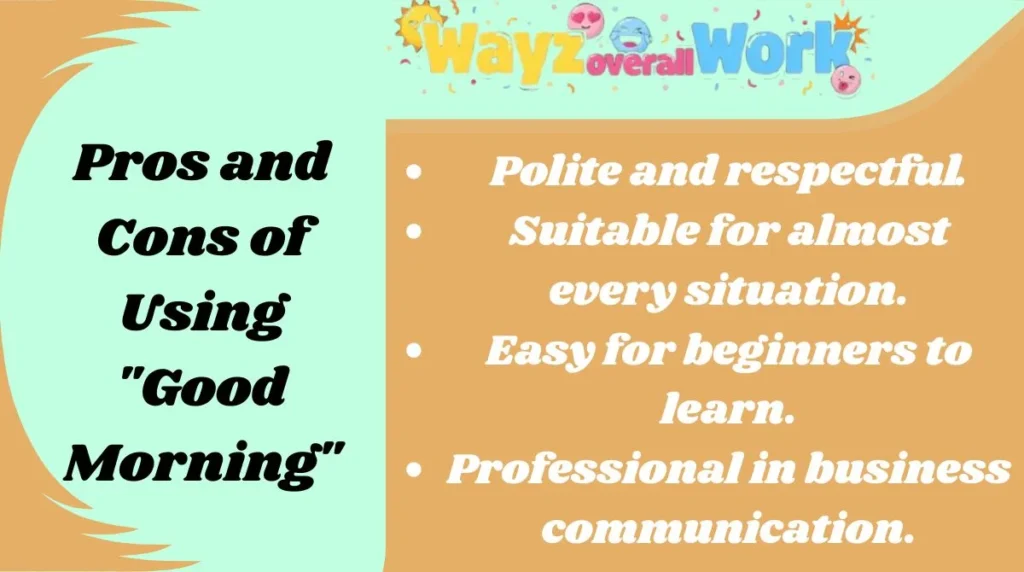
- Polite and respectful.
- Suitable for almost every situation.
- Easy for beginners to learn.
- Professional in business communication.
- Friendly without being too casual.
- Understood by English speakers around the world.
✘ Cons
- Can sound repetitive if used every day.
- May feel too formal among close friends.
- Less natural in casual text messages.
- Doesn’t add much personality to your greeting.
- Some workplaces prefer slightly warmer openings in emails.
Quick Alternatives List
If you need a fast replacement, try one of these greetings:
- Morning!
- Good day
- Hello
- Hi there
- Greetings
- Top of the morning
- Hope you’re having a great morning
- Wishing you a wonderful morning
- Rise and shine
- Have a lovely morning
- A very good morning to you
- Hope your day starts well
- It’s great to see you this morning
- Pleasure to see you this morning
- Welcome and good morning
- Bright morning to you
- Happy morning
- Hope you slept well
- Have a fantastic day
- Good to see you this morning
Morning!
Phrase
Morning!
Meaning
A short and casual version of good morning.
Explanation
Native English speakers often drop the word good during casual conversations. Saying Morning! sounds relaxed, friendly, and natural. It is common among friends, coworkers, classmates, and neighbors.
Grammar Note
Informal greeting.
Example Sentence
Morning, Alex! Ready for today’s meeting?
Best Use
Informal conversations, workplace chats, text messages, and friendly greetings.
Worst Use
Formal speeches, job interviews, official ceremonies, or highly professional emails.
Tone
Friendly
Level
Beginner
Similarity Score
10/10
Replaceability Tip
Use Morning! whenever you want to sound more relaxed while keeping the same meaning as good morning.
Hello
Phrase
Hello
Meaning
A general greeting that works at any time of the day.
Explanation
Unlike good morning, hello is not limited to the morning. It is polite, flexible, and suitable for both personal and professional communication.
Grammar Note
Greeting.
Example Sentence
Hello, everyone. Thank you for joining us today.
Best Use
Meetings, phone calls, emails, classrooms, and everyday conversations.
Worst Use
When you specifically want to acknowledge that it is morning.
Tone
Neutral
Level
Beginner
Similarity Score
8/10
Replaceability Tip
Choose hello if the time of day is not important.
Hi There
Phrase
Hi there
Meaning
A warm and friendly greeting.
Explanation
Hi there feels welcoming and conversational. It is common in customer service, online chats, friendly emails, and casual conversations.
Grammar Note
Informal greeting.
Example Sentence
Hi there! It’s great to see you again.
Best Use
Friends, customers, online messages, and social media.
Worst Use
Formal business letters or academic presentations.
Tone
Friendly
Level
Beginner
Similarity Score
7/10
Replaceability Tip
Use Hi there when you want your greeting to sound warmer than good morning.
Greetings
Phrase
Greetings
Meaning
A formal and respectful way to say hello.
Explanation
Greetings is often used in professional writing, announcements, formal emails, or ceremonial speeches. It sounds more official than good morning because it is not tied to a specific time of day.
Grammar Note
Formal greeting.
Example Sentence
Greetings, everyone, and welcome to today’s conference.
Best Use
Formal emails, presentations, official announcements, and business communication.
Worst Use
Casual conversations with friends.
Tone
Formal
Level
Intermediate
Similarity Score
8/10
Replaceability Tip
Use Greetings when you need a respectful opening without mentioning the time of day.
Rise and Shine
Phrase
Rise and shine
Meaning
A cheerful way to tell someone to wake up and start the day.
Explanation
Rise and shine is a common English expression that encourages someone to get out of bed and begin the morning with energy. Parents often say it to children, and friends may use it jokingly. It sounds warm, playful, and encouraging rather than formal.
Grammar Note
Idiom and informal greeting.
Example Sentence
Rise and shine! It’s a beautiful morning outside.
Best Use
Family, close friends, children, casual conversations, and text messages.
Worst Use
Business meetings, interviews, formal emails, or conversations with clients.
Tone
Friendly
Level
Intermediate
Similarity Score
7/10
Replaceability Tip
Choose Rise and shine when greeting someone who is just waking up.
Good Day
Phrase
Good day
Meaning
A polite greeting that wishes someone a pleasant day.
Explanation
Good day is more formal than good morning. In some countries, such as Australia and South Africa, it is still used in everyday conversation. In American English, it may sound a little old-fashioned but remains polite.
Grammar Note
Formal greeting.
Example Sentence
Good day, everyone. Thank you for joining today’s event.
Best Use
Formal conversations, customer service, and professional settings.
Worst Use
Casual chats with close friends who expect relaxed language.
Tone
Formal
Level
Intermediate
Similarity Score
8/10
Replaceability Tip
Use Good day when you want a respectful greeting without mentioning a specific time.
A Very Good Morning to You
Phrase
A very good morning to you
Meaning
A warm and highly respectful morning greeting.
Explanation
This expression sounds more elegant than simply saying good morning. Speakers often use it during speeches, presentations, ceremonies, or formal gatherings. It creates a welcoming atmosphere and shows extra courtesy.
Grammar Note
Formal greeting.
Example Sentence
A very good morning to you all, and welcome to our annual conference.
Best Use
Public speaking, business events, schools, and formal meetings.
Worst Use
Quick text messages or casual conversations.
Tone
Professional
Level
Advanced
Similarity Score
10/10
Replaceability Tip
Choose this expression when addressing a group in a formal setting.
Hope You’re Having a Great Morning
Phrase
Hope you’re having a great morning
Meaning
A friendly greeting that also wishes someone well.
Explanation
This phrase does more than greet the listener. It shows kindness and genuine interest in their day. It works especially well in emails because it creates a positive first impression.
Grammar Note
Greeting sentence.
Example Sentence
Hope you’re having a great morning. I wanted to follow up on our meeting yesterday.
Best Use
Emails, customer service, business communication, and friendly conversations.
Worst Use
Fast greetings when you need to get straight to the point.
Tone
Friendly and professional
Level
Intermediate
Similarity Score
9/10
Replaceability Tip
Use this greeting to make emails feel warmer and more personal.
Have a Wonderful Morning
Phrase
Have a wonderful morning
Meaning
A polite wish for someone to enjoy their morning.
Explanation
Unlike good morning, this phrase focuses on the future instead of the present. It is often used when leaving someone or ending a conversation.
Grammar Note
Well-wishing expression.
Example Sentence
Thank you for visiting our office. Have a wonderful morning.
Best Use
Customer service, workplaces, schools, and polite conversations.
Worst Use
As the very first greeting when meeting someone.
Tone
Warm
Level
Beginner
Similarity Score
8/10
Replaceability Tip
Choose this phrase when saying goodbye during the morning.
Hope You Slept Well
Phrase
Hope you slept well
Meaning
A caring way to greet someone after they wake up.
Explanation
This expression is personal and thoughtful. It is commonly used with family members, close friends, or romantic partners. It sounds caring because it asks about the person’s rest instead of simply greeting them.
Grammar Note
Greeting sentence.
Example Sentence
Good morning! Hope you slept well.
Best Use
Family, close friends, and loved ones.
Worst Use
Business meetings or conversations with strangers.
Tone
Warm and caring
Level
Beginner
Similarity Score
6/10
Replaceability Tip
Use it when you know the person well and want to sound thoughtful.
It’s Great to See You This Morning
Phrase
It’s great to see you this morning
Meaning
A welcoming greeting that shows happiness about meeting someone.
Explanation
This phrase adds warmth and appreciation. It tells the listener that their presence is valued. It is common in workplaces, conferences, classrooms, and meetings.
Grammar Note
Greeting sentence.
Example Sentence
It’s great to see you this morning. Let’s begin our discussion.
Best Use
Meetings, presentations, classrooms, and professional events.
Worst Use
Very casual text messages where a shorter greeting sounds more natural.
Tone
Professional and friendly
Level
Intermediate
Similarity Score
8/10
Replaceability Tip
Use this phrase when welcoming someone at the beginning of an event.
Pleasure to See You This Morning
Phrase
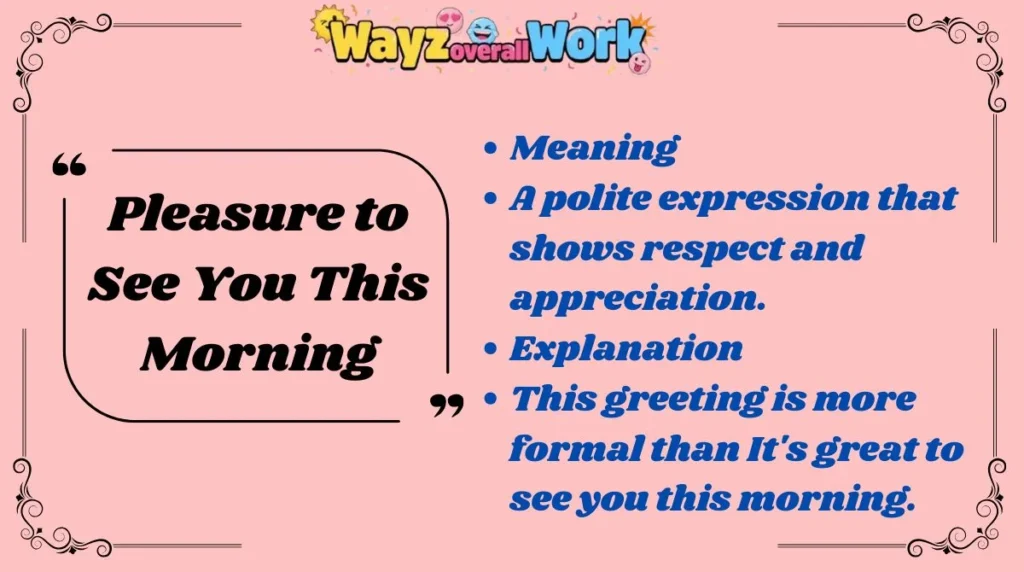
Pleasure to see you this morning
Meaning
A polite expression that shows respect and appreciation.
Explanation
This greeting is more formal than It’s great to see you this morning. It is common when meeting clients, guests, or senior colleagues.
Grammar Note
Formal greeting.
Example Sentence
It’s a pleasure to see you this morning. Thank you for taking the time to meet with us.
Best Use
Business meetings, interviews, networking events, and formal introductions.
Worst Use
Messages between close friends.
Tone
Professional
Level
Advanced
Similarity Score
8/10
Replaceability Tip
Choose this greeting when making an excellent first impression.
Welcome and Good Morning
Phrase
Welcome and good morning
Meaning
A greeting used to welcome people while wishing them a good morning.
Explanation
This expression is popular in meetings, seminars, webinars, classrooms, and public events. It immediately makes guests feel included.
Grammar Note
Formal welcoming phrase.
Example Sentence
Welcome and good morning, everyone. We’re delighted to have you here today.
Best Use
Events, conferences, workshops, training sessions, and presentations.
Worst Use
Private conversations with family members.
Tone
Professional
Level
Intermediate
Similarity Score
10/10
Replaceability Tip
Use it whenever you are greeting a group of people at the start of an event.
Bright Morning to You
Phrase
Bright morning to you
Meaning
A cheerful greeting wishing someone a happy morning.
Explanation
This expression is uncommon in everyday English but sounds positive and uplifting. Writers sometimes use it in creative writing, greeting cards, or motivational messages.
Grammar Note
Greeting phrase.
Example Sentence
Bright morning to you! May today bring you success and happiness.
Best Use
Greeting cards, inspirational posts, and creative writing.
Worst Use
Formal business emails or professional reports.
Tone
Cheerful
Level
Advanced
Similarity Score
6/10
Replaceability Tip
Use this expression when you want your greeting to sound creative and memorable.
- Mini dialogue examples
- Common learner mistakes
- UK vs US cultural and tone tips
- Comparison table
- 6 SEO-friendly FAQs
- Conclusion
- SEO meta description
Happy Morning
Phrase
Happy morning
Meaning
A cheerful greeting that wishes someone a pleasant morning.
Explanation
Although happy morning is understandable, native English speakers do not use it very often. They usually prefer good morning or have a great morning. You may see happy morning in greeting cards, motivational quotes, or social media posts, but it is uncommon in everyday conversation.
Grammar Note
Greeting phrase.
Example Sentence
Happy morning! I hope today brings you lots of success.
Best Use
Greeting cards, inspirational messages, and social media.
Worst Use
Business emails, interviews, or professional meetings.
Tone
Friendly
Level
Intermediate
Similarity Score
6/10
Replaceability Tip
If you want to sound like a native speaker, choose good morning or have a wonderful morning instead.
Hope Your Day Starts Well
Phrase
Hope your day starts well
Meaning
A kind way to wish someone a good beginning to the day.
Explanation
This greeting sounds caring and supportive. It is especially useful in emails because it feels personal without being too informal. It shows that you care about the other person’s well-being.
Grammar Note
Greeting sentence.
Example Sentence
Hope your day starts well. I wanted to share this week’s project update.
Best Use
Professional emails, friendly messages, and customer communication.
Worst Use
Quick face-to-face greetings.
Tone
Warm and professional
Level
Intermediate
Similarity Score
8/10
Replaceability Tip
Use this instead of good morning when writing a thoughtful email.
Have a Fantastic Day
Phrase
Have a fantastic day
Meaning
A positive wish for someone’s entire day.
Explanation
This phrase is usually said when ending a conversation rather than beginning one. It leaves people with a friendly and optimistic feeling.
Grammar Note
Well-wishing expression.
Example Sentence
Thanks for stopping by. Have a fantastic day!
Best Use
Customer service, workplaces, and casual conversations.
Worst Use
As the first greeting when meeting someone.
Tone
Friendly
Level
Beginner
Similarity Score
7/10
Replaceability Tip
Choose this phrase when saying goodbye in the morning.
Wishing You a Wonderful Morning
Phrase
Wishing you a wonderful morning
Meaning
A polite and thoughtful way to greet someone.
Explanation
This expression sounds more elegant than good morning. It is common in professional emails, newsletters, and greeting cards because it combines a greeting with a kind wish.
Grammar Note
Greeting sentence.
Example Sentence
Wishing you a wonderful morning and a productive week ahead.
Best Use
Emails, newsletters, greeting cards, and professional communication.
Worst Use
Very casual conversations with close friends.
Tone
Professional and warm
Level
Advanced
Similarity Score
9/10
Replaceability Tip
Use this greeting when you want to sound thoughtful and professional.
Top of the Morning
Phrase
Top of the morning
Meaning
A cheerful morning greeting.
Explanation
Many people believe this is a common Irish greeting, but it is actually quite rare in modern Ireland. Native English speakers usually use it jokingly or playfully rather than in everyday conversation.
Grammar Note
Idiom.
Example Sentence
Top of the morning to you! Ready for today’s adventure?
Best Use
Humorous conversations, storytelling, and playful greetings.
Worst Use
Business meetings, interviews, and formal emails.
Tone
Playful
Level
Advanced
Similarity Score
7/10
Replaceability Tip
Use this only if you want a lighthearted and humorous greeting.
Mini Dialogue Examples
Formal Conversation
Manager: Good morning, everyone.
Employee: Good morning. Thank you for inviting us.
Manager: It’s great to see you this morning. Let’s begin today’s meeting.
Informal Conversation
Emma: Morning!
Jack: Morning! How did you sleep?
Emma: Great! Ready for breakfast?
Business Email Example
Subject: Project Update
Hello Sarah,
Hope you’re having a great morning.
I’m writing to share the latest progress on our project. Please let me know if you have any questions.
Kind regards,
David
Mistakes to Avoid
Many English learners make small mistakes when greeting people. Avoid these common errors.
- Saying Good morning late in the afternoon. Use Good afternoon instead.
- Using Hey! in professional emails.
- Writing Happy morning in business communication. Native speakers usually prefer Good morning.
- Using Rise and shine with customers or your manager. It sounds too playful.
- Starting every email with the exact same greeting. Add variety when appropriate.
- Forgetting punctuation in emails, such as Good morning, Sarah,.
- Using overly casual greetings during job interviews or formal presentations.
Cultural and Tone Tips
English greetings can change slightly depending on the country and situation.
UK English
People in the UK commonly say Good morning in workplaces and formal settings. Among friends, Morning! is very common and sounds natural.
US English
Americans often use Good morning, Morning!, Hi, and Hello. In many offices, greetings become less formal after coworkers know each other well.
Casual Social English
Friends usually choose short greetings such as:
- Morning!
- Hey!
- Hi!
- What’s up?
- How’s it going?
These greetings sound relaxed but are not suitable for formal business situations.
Comparison Table
| Phrase | Tone | Best Context | Professional Level | Example |
|---|---|---|---|---|
| Good Morning | Professional | Every situation | High | Good morning, everyone. |
| Morning! | Friendly | Friends and coworkers | Medium | Morning! Ready to go? |
| Hello | Neutral | Meetings and calls | High | Hello, everyone. |
| Greetings | Formal | Official emails | Very High | Greetings, team. |
| Hope You’re Having a Great Morning | Warm | Professional emails | High | Hope you’re having a great morning. |
| A Very Good Morning to You | Formal | Speeches | Very High | A very good morning to you all. |
| Rise and Shine | Playful | Family and friends | Low | Rise and shine! |
Frequently Asked Questions
Is good morning rude?
No. It is one of the politest greetings in English and is suitable for almost every situation.
Is good morning okay in emails?
Yes. It is widely used in business and professional emails, especially before noon.
What is the most formal alternative to good morning?
A very good morning to you and Greetings are among the most formal alternatives.
What is the friendliest alternative?
Morning! is one of the most natural and friendly choices for everyday conversation.
Which greeting should beginners use?
Beginners should use Good morning, Hello, and Morning! because they are easy, natural, and widely understood.
Can I use good morning after 12 p.m.?
Generally, no. After noon, native speakers usually switch to Good afternoon.
Conclusion
Learning different ways to say good morning helps you become a more confident English speaker. Each greeting has its own tone, level of formality, and best situation.
Some expressions are perfect for business meetings and professional emails, while others are better for friends, family, or casual conversations.
The more greetings you learn, the more natural your English will sound. Practice using these alternatives in real conversations, emails, and daily communication.
Over time, choosing the right greeting will become automatic, helping you build stronger relationships and make a positive first impression wherever you go.

Rashmeer is a passionate writer and content creator dedicated to delivering clear, engaging, and reliable information. With a focus on quality and authenticity, Rashmeer creates content that informs, inspires, and helps readers discover practical ideas and fresh perspectives.