
The phrase “I said” is one of the most common reporting expressions in English. People use it to repeat their own words, tell a story, write dialogue, or explain what they told someone earlier.
While it is correct and easy to understand, using it again and again can make your speaking and writing sound repetitive.
Learning other ways to say “I said” helps you sound more natural, confident, and fluent. Different expressions also help you match the right tone.
Some are perfect for business emails, while others work better in casual conversations, essays, meetings, or social media posts.
The words you choose can change how people understand your message. A professional alternative can make your writing sound polished, while a friendly expression can make conversations feel warmer and more natural.
Example:
Formal: I explained that the project would finish on Friday.
Informal: I told them we’d be done by Friday.
Choosing the right expression makes your communication clearer and more effective.
What Does “I Said” Mean?
“I said” means that you spoke or expressed something to another person. It tells the reader or listener what you communicated earlier.
It is commonly used when reporting speech, sharing conversations, giving instructions, or repeating information.
Grammar Form:
“I said” is the past tense of the verb say.
- Base verb: say
- Past tense: said
- Part of speech: verb
Similar Expressions
- I told
- I explained
- I mentioned
- I stated
- I replied
- I added
- I answered
- I informed
Opposite Ideas
Depending on the situation, opposite meanings include:
- I stayed silent.
- I kept quiet.
- I didn’t mention it.
- I remained silent.
- I withheld my opinion.
Example Sentences
- I said I would arrive before noon.
- I said thank you before leaving the meeting.
When to Use “I Said”
Spoken English
“I said” is very common in everyday conversations.
Examples:
- I said I wasn’t hungry.
- I said we could meet tomorrow.
It sounds natural in casual speech and storytelling.
Business English
In workplaces, “I said” is acceptable when referring to previous conversations. However, more professional alternatives often sound better.
Example:
- I mentioned this during yesterday’s meeting.
- I explained the process to the client.
Emails and Messages
You can use “I said” when reminding someone of earlier communication, but it may sound too direct in formal emails.
Instead of:
- I said this last week.
Try:
- As I mentioned last week…
- As discussed previously…
These sound more professional and polite.
Social Media
“I said” works well when sharing stories, opinions, or personal experiences.
Examples:
- I said yes immediately.
- I said exactly what I felt.
Casual language is completely acceptable here.
Academic Writing
Academic writing usually avoids “I said” because it sounds conversational.
Instead, writers often use:
- I argued
- I observed
- I noted
- I stated
These expressions create a stronger academic tone.
Professional Meetings
During meetings, alternatives sound more polished.
Examples:
- I suggested changing the schedule.
- I clarified our priorities.
- I emphasized the deadline.
These verbs describe exactly how something was communicated.
Is “I Said” Polite or Professional?
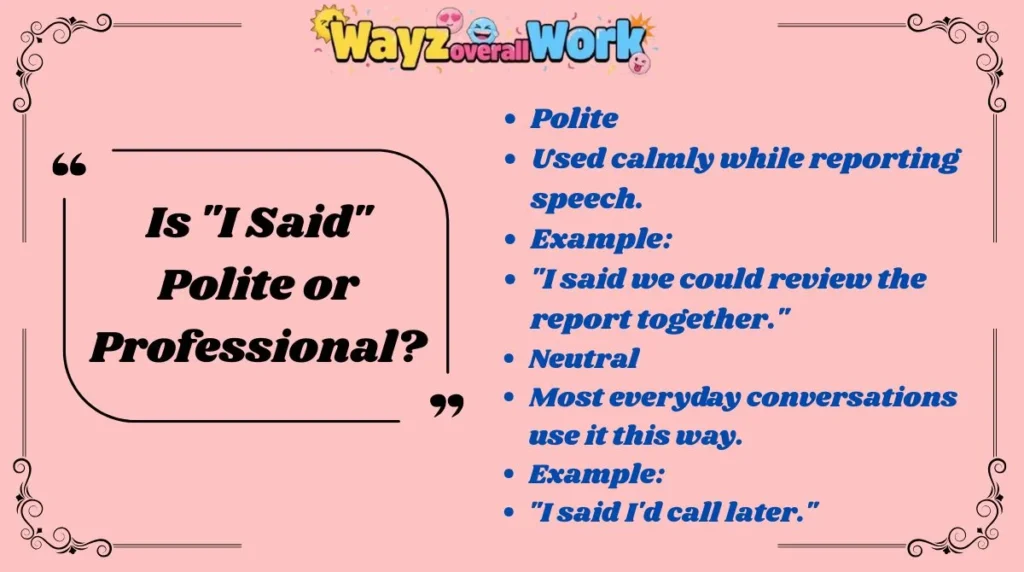
The phrase itself is neither rude nor impolite. Its tone depends on the context.
Polite
Used calmly while reporting speech.
Example:
“I said we could review the report together.”
Neutral
Most everyday conversations use it this way.
Example:
“I said I’d call later.”
Strong
When spoken with emphasis, it can sound impatient.
Example:
“I said stop.”
Here the tone becomes forceful.
Soft
When paired with polite language, it sounds gentle.
Example:
“I said we might consider another option.”
Formal vs. Informal
Formal
Although correct, formal writing often replaces it with more precise verbs.
Examples:
- I explained
- I stated
- I noted
- I informed
Informal
“I said” is perfectly natural among friends and family.
Etiquette Tip
For workplace communication, choose expressions like “I mentioned,” “I explained,” or “I noted” instead of repeatedly writing “I said.” They sound more professional and respectful, especially in corporate emails.
Pros & Cons of Using “I Said”
✔ Pros
- Easy to understand.
- Common in everyday English.
- Works in conversations.
- Suitable for storytelling.
- Good for beginners.
- Grammatically simple.
- Natural in speech.
✘ Cons
- Sounds repetitive in long writing.
- Lacks detail about how something was communicated.
- Less professional in formal documents.
- Weakens creative writing.
- Can make dialogue feel repetitive.
- Better alternatives often sound clearer.
Quick Alternatives List
If you need a fast replacement, here are some of the best alternatives to “I said.”
- I told
- I explained
- I mentioned
- I stated
- I informed
- I noted
- I replied
- I answered
- I added
- I suggested
- I clarified
- I pointed out
- I reminded
- I emphasized
- I announced
- I commented
- I shared
- I expressed
I Told
Meaning
To give someone information directly.
Explanation
“I told” is one of the closest alternatives to “I said.” Unlike say, the verb tell almost always has an object. You tell someone something. It feels more direct and personal.
Grammar Note
Past tense verb.
Example Sentence
I told my manager that the report was complete.
Best Use
Informal, workplace, conversations, emails.
Worst Use
Do not use it without mentioning who was told when the sentence requires an object.
Incorrect:
I told that I was busy.
Correct:
I told him that I was busy.
Tone
Neutral
Level
Beginner
Similarity Score
10/10
Replaceability Tip
Choose “I told” when you want to show that your message was directed to a specific person.
I Explained
Meaning
To make something easy to understand.
Explanation
“I explained” tells readers that you gave extra details rather than simply speaking. It sounds professional and is common in business, education, and customer service.
Grammar Note
Past tense reporting verb.
Example Sentence
I explained how the software works during the training session.
Best Use
Business, workplace, academic writing, emails.
Worst Use
Avoid using it when you simply made a short comment without giving details.
Tone
Professional
Level
Beginner
Similarity Score
9.5/10
Replaceability Tip
Use “I explained” when your goal was to help someone understand a topic.
I Mentioned
Meaning
To refer to something briefly.
Explanation
“I mentioned” suggests that the information was not the main topic. It sounds softer than “I said” and is common in meetings and emails.
Grammar Note
Past tense verb.
Example Sentence
I mentioned the deadline during yesterday’s meeting.
Best Use
Professional writing, emails, meetings.
Worst Use
Do not use it if you gave a long explanation.
Tone
Soft and Professional
Level
Intermediate
Similarity Score
9/10
Replaceability Tip
Choose this expression when the information was only briefly discussed.
I Stated
Meaning
To express something clearly and formally.
Explanation
“I stated” sounds official and confident. It is often used in reports, legal writing, business communication, and formal discussions.
Grammar Note
Formal reporting verb.
Example Sentence
I stated the company’s policy during the meeting.
Best Use
Formal documents, business communication, presentations.
Worst Use
It may sound too serious in friendly conversations.
Tone
Formal
Level
Intermediate
Similarity Score
8.5/10
Replaceability Tip
Use “I stated” when you want your words to sound clear, factual, and authoritative.
I Informed
Meaning
To officially give information.
Explanation
“I informed” is more formal than “I said.” It often appears in workplace communication, customer support, and official announcements.
Grammar Note
Formal verb.
Example Sentence
I informed the client about the updated delivery schedule.
Best Use
Business emails, customer service, workplace communication.
Worst Use
It can sound overly formal when talking with close friends.
Tone
Professional
Level
Intermediate
Similarity Score
8.5/10
Replaceability Tip
Choose “I informed” when communicating official or important information.
I Noted
Meaning
To point out or record something important.
Explanation
“I noted” means you drew attention to a fact or observation. It often suggests that the information was worth remembering. This phrase is common in meetings, reports, presentations, and academic writing. Compared with “I said,” it sounds more thoughtful and professional.
Grammar Note
Past tense reporting verb.
Example Sentence
I noted that the budget had increased since last year.
Best Use
Business meetings, reports, academic writing, presentations.
Worst Use
Avoid using it for casual chats with friends because it can sound too formal.
Tone
Professional
Level
Intermediate
Similarity Score
8.5/10
Replaceability Tip
Use “I noted” when highlighting an important fact instead of simply repeating what you said.
I Replied
Meaning
To answer someone after they spoke.
Explanation
“I replied” shows that your words were a response to another person’s question or comment. It makes conversations and stories sound smoother because it clearly shows the order of speaking.
Grammar Note
Past tense reporting verb.
Example Sentence
When she thanked me, I replied with a smile.
Best Use
Conversations, stories, emails, text messages.
Worst Use
Do not use it if nobody spoke before you.
Tone
Neutral
Level
Beginner
Similarity Score
8/10
Replaceability Tip
Choose “I replied” whenever your words directly answer another person’s statement.
I Answered
Meaning
To respond to a question.
Explanation
While “I replied” can answer both statements and questions, “I answered” usually refers to answering a question. It is clear, simple, and easy for English learners to use.
Grammar Note
Past tense verb.
Example Sentence
I answered all of the customer’s questions before the meeting ended.
Best Use
Interviews, classrooms, conversations, customer service.
Worst Use
Avoid using it when nobody asked a question.
Tone
Neutral
Level
Beginner
Similarity Score
8/10
Replaceability Tip
Use “I answered” when responding to a direct question rather than making a general statement.
I Added
Meaning
To give extra information.
Explanation
“I added” tells readers that you continued speaking after your first comment. It helps show that you included another thought, detail, or opinion.
Writers often use this verb in articles, interviews, books, and news reports because it creates smooth transitions between ideas.
Grammar Note
Past tense reporting verb.
Example Sentence
I added that we could finish the project ahead of schedule.
Best Use
Articles, meetings, interviews, emails, conversations.
Worst Use
Do not use it if there was no previous statement.
Tone
Neutral
Level
Beginner
Similarity Score
8.5/10
Replaceability Tip
Choose “I added” when introducing additional information after your first statement.
I Suggested
Meaning
To give an idea or recommendation.
Explanation
“I suggested” means you offered advice without forcing anyone to accept it. It sounds polite, cooperative, and professional. Managers, teachers, and coworkers frequently use this expression.
Grammar Note
Past tense verb.
Example Sentence
I suggested meeting on Monday instead of Friday.
Best Use
Workplace discussions, meetings, emails, team projects.
Worst Use
Avoid using it if you were giving a direct order instead of a recommendation.
Tone
Professional and Friendly
Level
Intermediate
Similarity Score
7.5/10
Replaceability Tip
Use “I suggested” when your goal is to offer an idea rather than simply report what you said.
I Clarified
Meaning
To make something clearer.
Explanation
“I clarified” tells people that you removed confusion or corrected a misunderstanding. It is especially useful in business communication, customer support, education, and professional presentations.
Compared with “I said,” it shows that your purpose was to improve understanding rather than simply speak.
Grammar Note
Past tense reporting verb.
Example Sentence
I clarified that the deadline applies to every department.
Best Use
Business emails, meetings, presentations, customer support.
Worst Use
Do not use it if no misunderstanding existed.
Tone
Professional
Level
Intermediate
Similarity Score
8/10
Replaceability Tip
Choose “I clarified” when explaining something again to remove confusion.
I Pointed Out
Meaning
To draw attention to something important.
Explanation
“I pointed out” means you highlighted a fact, problem, or detail that others may not have noticed. It is common in discussions, reviews, presentations, and workplace communication.
This expression often carries a helpful or corrective tone.
Grammar Note
Phrasal verb.
Example Sentence
I pointed out the spelling mistake before the report was printed.
Best Use
Meetings, reports, classrooms, workplace discussions.
Worst Use
It may sound critical if used too often during friendly conversations.
Tone
Professional
Level
Intermediate
Similarity Score
7.5/10
Replaceability Tip
Use this phrase when you want to emphasize an important detail that deserves attention.
I Reminded
Meaning
To help someone remember something.
Explanation
“I reminded” means you repeated information that the other person already knew or should know. It is polite and practical in workplaces, schools, and family conversations.
Grammar Note
Past tense reporting verb.
Example Sentence
I reminded everyone to submit their reports before Friday.
Best Use
Emails, meetings, classrooms, workplace communication.
Worst Use
Avoid using it if the information is completely new.
Tone
Friendly and Professional
Level
Beginner
Similarity Score
7/10
Replaceability Tip
Choose “I reminded” when repeating information instead of introducing it for the first time.
I Emphasized
Meaning
To give special importance to something.
Explanation
“I emphasized” shows that you intentionally stressed a key point. It is stronger than “I said” because it tells readers that the message deserved extra attention.
It is widely used in presentations, business meetings, speeches, and academic writing.
Grammar Note
Formal reporting verb.
Example Sentence
I emphasized the importance of meeting the deadline.
Best Use
Business presentations, speeches, reports, academic writing.
Worst Use
Avoid using it when discussing unimportant details.
Tone
Strong and Professional
Level
Advanced
Similarity Score
7.5/10
Replaceability Tip
Use “I emphasized” whenever your message was especially important.
I Announced
Meaning
To make information public.
Explanation
“I announced” means you officially shared news with a group. It often refers to important updates, decisions, or events.
Unlike “I said,” this expression suggests that many people were listening.
Grammar Note
Formal reporting verb.
Example Sentence
I announced the winners during the closing ceremony.
Best Use
Events, business announcements, schools, organizations.
Worst Use
Avoid using it for private conversations.
Tone
Formal
Level
Intermediate
Similarity Score
7/10
Replaceability Tip
Choose “I announced” when sharing important news with an audience.
I Commented
Meaning
To share your opinion about something.
Explanation
“I commented” means you gave a remark, opinion, or reaction. It does not always mean you started the conversation. Instead, it shows that you added your thoughts after seeing, hearing, or reading something. This phrase is common in meetings, interviews, online discussions, and social media.
Grammar Note
Past tense reporting verb.
Example Sentence
I commented that the new design looked much cleaner.
Best Use
Meetings, blogs, online discussions, interviews, social media.
Worst Use
Avoid using it when giving official instructions or formal announcements.
Tone
Neutral
Level
Intermediate
Similarity Score
7/10
Replaceability Tip
Use “I commented” when you are giving an opinion rather than simply repeating what you said.
I Shared
Meaning
To tell someone your thoughts, ideas, or experiences.
Explanation
“I shared” sounds warm and friendly. It often suggests openness and cooperation. In workplaces, it can also sound more positive than “I said.” Many professionals use it when discussing ideas during meetings or presentations.
Grammar Note
Past tense reporting verb.
Example Sentence
I shared my experience with the new software during the workshop.
Best Use
Workplace, teamwork, presentations, conversations, social media.
Worst Use
Avoid using it when referring to strict rules or official statements.
Tone
Friendly and Professional
Level
Beginner
Similarity Score
7.5/10
Replaceability Tip
Choose “I shared” when you want your message to sound open, supportive, and collaborative.
I Expressed
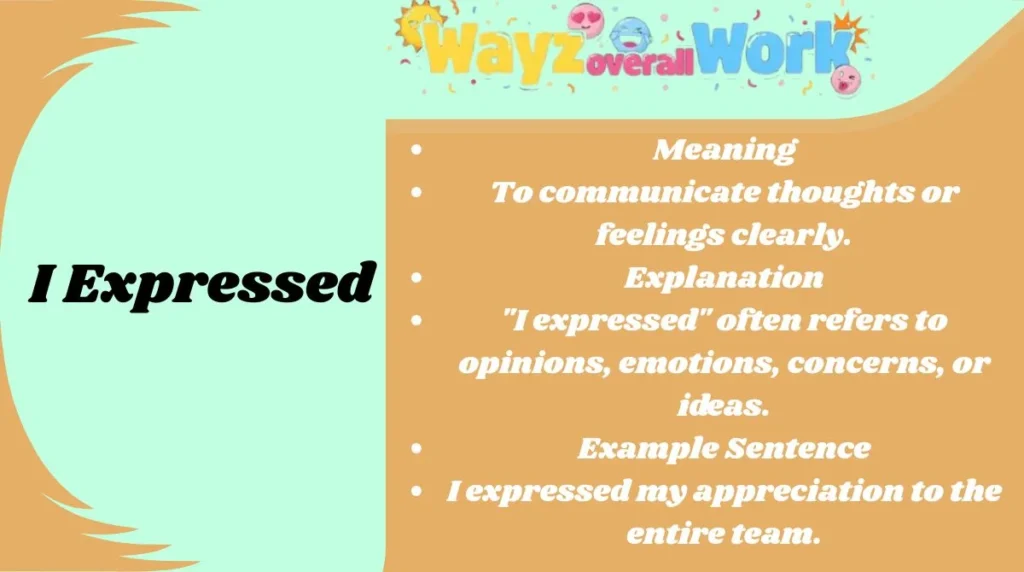
Meaning
To communicate thoughts or feelings clearly.
Explanation
“I expressed” often refers to opinions, emotions, concerns, or ideas. It sounds more formal than “I said” and is frequently used in business writing, academic papers, and professional communication.
Grammar Note
Formal reporting verb.
Example Sentence
I expressed my appreciation to the entire team.
Best Use
Business writing, professional emails, academic work, presentations.
Worst Use
Avoid using it for very simple everyday dialogue where “I said” sounds more natural.
Tone
Professional
Level
Intermediate
Similarity Score
8/10
Replaceability Tip
Use “I expressed” when talking about feelings, opinions, gratitude, or concerns.
I Observed
Meaning
To say something based on what you noticed.
Explanation
“I observed” means you made a thoughtful comment after noticing a fact or situation. It is common in formal discussions, research, reports, and academic writing.
Grammar Note
Formal reporting verb.
Example Sentence
I observed that customer satisfaction had improved over the past year.
Best Use
Reports, research, academic writing, business meetings.
Worst Use
Avoid using it for everyday casual conversations because it may sound overly formal.
Tone
Formal
Level
Advanced
Similarity Score
6.5/10
Replaceability Tip
Choose “I observed” when your statement comes from careful observation rather than ordinary conversation.
I Remarked
Meaning
To make a short spoken comment.
Explanation
“I remarked” means you made a brief statement or observation. It appears often in books, news articles, interviews, and formal storytelling. Although native speakers understand it well, it is less common in everyday conversation than “I said.”
Grammar Note
Formal reporting verb.
Example Sentence
I remarked that the weather had changed quickly.
Best Use
Books, storytelling, interviews, formal writing.
Worst Use
Avoid overusing it in casual conversations because it can sound literary.
Tone
Formal
Level
Advanced
Similarity Score
7/10
Replaceability Tip
Use “I remarked” when writing stories or formal reports that need more varied vocabulary.
Mini Dialogue Examples
Formal Conversation
Manager: Did everyone understand the new policy?
Employee: Yes. I explained the updated procedure to the entire team this morning.
Manager: Excellent. Thank you for making everything clear.
Informal Conversation
Emma: Did you tell Jake about the movie?
Liam: Yes. I told him we were meeting at seven.
Emma: Great! I’ll see you both there.
Business Email Example
Subject: Project Timeline Update
Hello Sarah,
As I mentioned during yesterday’s meeting, the project is on schedule. I also clarified the revised deadline with the design team.
Please let me know if you have any questions.
Best regards,
David
Mistakes to Avoid
Many English learners make small mistakes when replacing “I said.” Avoid these common errors.
- Using “I told” without an object when one is needed.
- ❌ I told that I was busy.
- ✅ I told my manager that I was busy.
- Using “I answered” when nobody asked a question.
- Choosing “I announced” for private conversations instead of public news.
- Using very formal words like “I stated” or “I observed” when chatting with friends.
- Repeating the same reporting verb throughout an essay or story.
- Confusing say and tell in reported speech.
- Using strong verbs like “I emphasized” when the point was not actually important.
Cultural & Tone Tips
Native English speakers use different reporting verbs depending on the situation. Choosing the right one helps your English sound more natural.
UK English
British English often uses formal reporting verbs in newspapers, business writing, and official communication. Words like “I remarked,” “I noted,” and “I observed” appear more often in written English than in casual speech.
US English
American English usually prefers simple and direct language. Expressions like “I told,” “I explained,” “I mentioned,” and “I shared” are very common in daily conversations and workplaces.
Casual Social English
Friends usually keep things simple.
Common choices include:
- I told
- I said
- I mentioned
- I shared
Very formal expressions such as “I stated” or “I observed” may sound stiff in relaxed conversations.
Tip: Match your reporting verb to the situation. Professional settings often require more formal language, while everyday conversations sound best with simpler expressions.
Comparison Table
| Phrase | Tone | Best Context | Professional Level | Example |
|---|---|---|---|---|
| I told | Neutral | Everyday conversations | Medium | I told my friend about the meeting. |
| I explained | Professional | Workplace, teaching | High | I explained the process to the client. |
| I mentioned | Soft | Emails, meetings | High | I mentioned the deadline yesterday. |
| I stated | Formal | Reports, official documents | Very High | I stated the company policy clearly. |
| I clarified | Professional | Meetings, customer support | High | I clarified the revised schedule. |
| I shared | Friendly | Teamwork, presentations | Medium | I shared my experience with the group. |
| I emphasized | Strong | Speeches, presentations | Very High | I emphasized the importance of safety. |
FAQs
Is “I said” rude?
No. It is a neutral expression. However, your tone of voice can make it sound polite or impatient.
Is “I said” okay in emails?
Yes, but alternatives like “I mentioned” or “I explained” often sound more professional.
What is the most formal alternative?
“I stated” and “I informed” are among the most formal alternatives.
What is the most polite alternative?
“I mentioned” is one of the softest and most polite choices in professional communication.
Which alternative should beginners use?
“I told,” “I explained,” and “I mentioned” are simple, common, and easy to learn.
Which alternative is best for the workplace?
“I explained,” “I clarified,” “I informed,” and “I mentioned” work well in most professional situations.
Conclusion
Using different ways to say “I said” makes your English stronger, clearer, and more interesting. Instead of repeating the same phrase, you can choose words that match your purpose and your audience.
Whether you are writing an email, speaking in a meeting, telling a story, or completing an academic assignment, the right reporting verb improves both clarity and professionalism.
Start with simple alternatives like “I told” and “I explained.” As your confidence grows, practice more advanced expressions such as “I clarified,” “I emphasized,” and “I observed.”
The more you use these naturally in real conversations and writing, the more fluent and confident your English will become.

Rashmeer is a passionate writer and content creator dedicated to delivering clear, engaging, and reliable information. With a focus on quality and authenticity, Rashmeer creates content that informs, inspires, and helps readers discover practical ideas and fresh perspectives.