
The words sunrise and sunset describe two of the most beautiful moments of the day. Sunrise is when the sun appears above the horizon in the morning, while sunset is when it disappears below the horizon in the evening.
These simple words are common in everyday English, but they are not always the best choice for every situation.
Learning different ways to express the same idea helps you sound more natural and confident.
The right expression can make your writing more professional, your conversations more interesting, and your emails or essays more polished. It also helps you avoid repeating the same words again and again.
For example:
Formal: The ceremony will begin at daybreak.
Informal: Let’s meet at sunup.
Using the right alternative improves clarity, tone, and communication in every type of English.
What Does “Sunrise and Sunset” Mean?
Sunrise means the moment when the sun first appears in the morning.
Sunset means the moment when the sun disappears below the horizon in the evening.
These words are mainly nouns, although they are sometimes used as adjectives in phrases like sunrise hike or sunset view.
Similar expressions include:
- Dawn
- Daybreak
- First light
- Twilight
- Dusk
- Nightfall
Opposite ideas:
- Sunrise ↔ Sunset
- Dawn ↔ Dusk
- Morning ↔ Evening
Examples:
- We started hiking before sunrise.
- The beach looks magical at sunset.
When to Use “Sunrise and Sunset”
Spoken English
These words are perfect for daily conversations about travel, weather, photography, or outdoor activities.
Example:
“We watched the sunrise from the mountain.”
Business English
Use more polished alternatives when discussing schedules, tourism, hospitality, or event planning.
Example:
“The event begins at daybreak.”
Emails and Messages
Use standard terms for clarity, especially when discussing meeting times or travel plans.
Example:
“Our tour starts shortly after sunrise.”
Social Media
Creative alternatives sound more engaging in captions.
Example:
“Nothing beats the first light over the ocean.”
Academic Writing
Formal alternatives improve reports, essays, and research papers.
Example:
“Observations were recorded at dawn and dusk.”
Professional Meetings
Choose clear and formal wording.
Example:
“Maintenance operations will begin at daybreak.”
Is “Sunrise and Sunset” Polite or Professional?
The expressions themselves are polite and neutral.
Polite
Suitable in almost every conversation.
Neutral
Excellent for everyday speaking and writing.
Strong
Poetic alternatives can create stronger emotional impact.
Soft
Gentle expressions like first light or golden hour sound warm and pleasant.
Formal vs. Informal
Formal alternatives include:
- Daybreak
- Dawn
- Dusk
- Twilight
Informal alternatives include:
- Sunup
- Sundown
Etiquette Tip:
For workplace communication, use dawn, daybreak, or dusk. Avoid slang like sunup in corporate emails unless the audience is very informal.
Pros & Cons of Using “Sunrise and Sunset”
✔ Pros
- Easy to understand
- Common in all English-speaking countries
- Suitable for beginners
- Works in writing and speech
- Clear and accurate
✘ Cons
- Can become repetitive
- Less descriptive in creative writing
- Some situations need more formal wording
- May sound basic in professional content
Quick Alternatives List
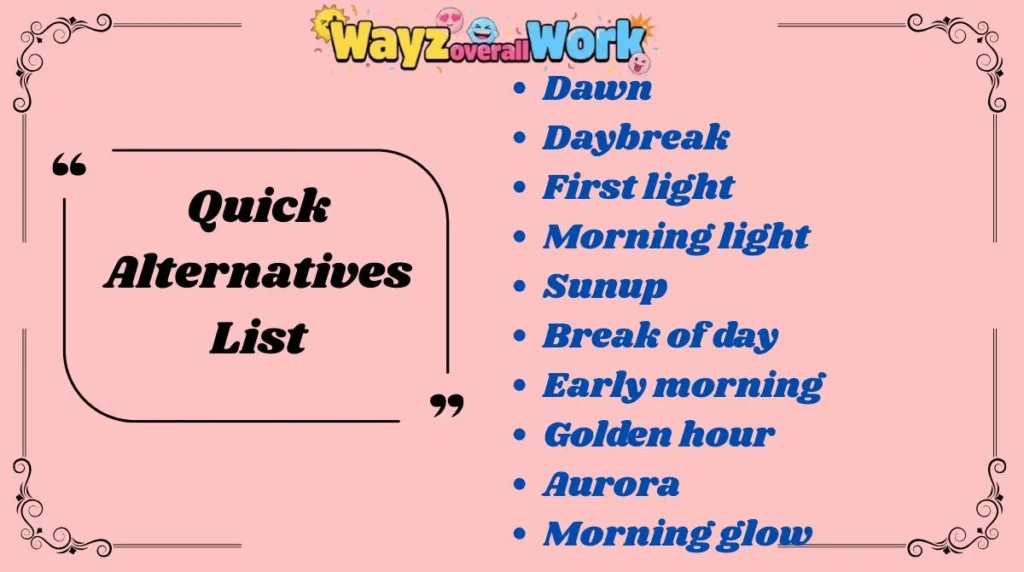
- Dawn
- Daybreak
- First light
- Morning light
- Sunup
- Break of day
- Early morning
- Golden hour
- Aurora
- Morning glow
- Dusk
- Twilight
- Nightfall
- Evening glow
- Sundown
- Last light
- Eventide
- Evening twilight
Dawn
Meaning:
The beginning of the day.
Explanation:
One of the closest and most natural alternatives to sunrise. It sounds elegant and works well in formal and literary English.
Grammar Note:
Noun.
Example Sentence:
The birds began singing at dawn.
Best Use:
Formal, academic, workplace, writing.
Worst Use:
Rarely unsuitable.
Tone:
Formal and neutral.
Level:
Beginner.
Similarity Score:
10/10
Replaceability Tip:
Choose dawn when you want a polished alternative to sunrise.
Daybreak
Meaning:
The time when daylight begins.
Explanation:
A formal expression often used in news, travel, and professional writing.
Grammar Note:
Noun.
Example Sentence:
Rescue teams departed at daybreak.
Best Use:
Professional, academic.
Worst Use:
Casual texting.
Tone:
Professional.
Level:
Intermediate.
Similarity Score:
9.5/10
Replaceability Tip:
Perfect for reports and official communication.
First Light
Meaning:
The earliest natural light of the morning.
Explanation:
Common in photography, travel, and storytelling.
Grammar Note:
Noun phrase.
Example Sentence:
Photographers arrived before first light.
Best Use:
Travel, photography, blogs.
Worst Use:
Scientific writing requiring precise timing.
Tone:
Soft.
Level:
Intermediate.
Similarity Score:
9/10
Replaceability Tip:
Use when describing beautiful scenery.
Sunup
Meaning:
Sunrise.
Explanation:
A casual American English expression.
Grammar Note:
Noun.
Example Sentence:
We left before sunup.
Best Use:
Casual speech.
Worst Use:
Corporate emails.
Tone:
Friendly.
Level:
Beginner.
Similarity Score:
10/10
Replaceability Tip:
Great for relaxed conversations.
Break of Day
Meaning:
The beginning of daylight.
Explanation:
A traditional phrase with a literary feel.
Grammar Note:
Noun phrase.
Example Sentence:
They started their journey at the break of day.
Best Use:
Stories and books.
Worst Use:
Informal texting.
Tone:
Formal.
Level:
Advanced.
Similarity Score:
9/10
Replaceability Tip:
Use when writing creatively.
Morning Light
Meaning:
Light during the early morning.
Explanation:
Focuses on the lighting rather than the exact time.
Grammar Note:
Noun phrase.
Example Sentence:
The flowers looked beautiful in the morning light.
Best Use:
Creative writing.
Worst Use:
Scheduling.
Tone:
Soft.
Level:
Beginner.
Similarity Score:
8/10
Replaceability Tip:
Best for descriptions.
Golden Hour
Meaning:
The period shortly after sunrise or before sunset.
Explanation:
Popular among photographers.
Grammar Note:
Noun phrase.
Example Sentence:
The photos were taken during the golden hour.
Best Use:
Photography and travel.
Worst Use:
General scheduling.
Tone:
Friendly.
Level:
Intermediate.
Similarity Score:
7.5/10
Replaceability Tip:
Use when discussing lighting.
Aurora
Meaning:
Dawn or early morning.
Explanation:
A poetic and literary alternative.
Grammar Note:
Noun.
Example Sentence:
The aurora painted the sky with soft colors.
Best Use:
Poetry.
Worst Use:
Business communication.
Tone:
Elegant.
Level:
Advanced.
Similarity Score:
7/10
Replaceability Tip:
Ideal for artistic writing.
Dusk
Meaning:
The time just before night.
Explanation:
The closest alternative to sunset.
Grammar Note:
Noun.
Example Sentence:
The park closes at dusk.
Best Use:
Professional and everyday English.
Worst Use:
None.
Tone:
Neutral.
Level:
Beginner.
Similarity Score:
10/10
Replaceability Tip:
Excellent replacement for sunset.
Twilight
Meaning:
The soft light after sunset or before sunrise.
Explanation:
Describes the transition between day and night.
Grammar Note:
Noun.
Example Sentence:
The mountains looked peaceful in the twilight.
Best Use:
Creative writing.
Worst Use:
Exact scheduling.
Tone:
Soft.
Level:
Intermediate.
Similarity Score:
8.5/10
Replaceability Tip:
Adds beauty to descriptions.
Nightfall
Meaning:
The beginning of night.
Explanation:
Focuses on darkness arriving.
Grammar Note:
Noun.
Example Sentence:
Everyone returned before nightfall.
Best Use:
Formal writing.
Worst Use:
When referring to the exact sunset.
Tone:
Professional.
Level:
Intermediate.
Similarity Score:
8/10
Replaceability Tip:
Use when darkness is the main idea.
Evening Glow
Meaning:
The warm light around sunset.
Explanation:
A descriptive phrase for beautiful scenery.
Grammar Note:
Noun phrase.
Example Sentence:
The lake reflected the evening glow.
Best Use:
Travel and blogs.
Worst Use:
Business writing.
Tone:
Friendly.
Level:
Intermediate.
Similarity Score:
7.5/10
Replaceability Tip:
Perfect for vivid descriptions.
Sundown
Meaning:
Sunset.
Explanation:
A casual alternative widely used in everyday English.
Grammar Note:
Noun.
Example Sentence:
We’ll arrive before sundown.
Best Use:
Conversation.
Worst Use:
Formal reports.
Tone:
Informal.
Level:
Beginner.
Similarity Score:
10/10
Replaceability Tip:
Great for relaxed communication.
Last Light
Meaning:
The final daylight before darkness.
Explanation:
Common in outdoor activities and photography.
Grammar Note:
Noun phrase.
Example Sentence:
Camp was set up before last light.
Best Use:
Travel.
Worst Use:
Scientific writing.
Tone:
Neutral.
Level:
Intermediate.
Similarity Score:
8/10
Replaceability Tip:
Use for outdoor adventures.
Eventide
Meaning:
Evening.
Explanation:
A traditional literary word for evening or sunset.
Grammar Note:
Noun.
Example Sentence:
The village became peaceful at eventide.
Best Use:
Poetry and literature.
Worst Use:
Business communication.
Tone:
Formal.
Level:
Advanced.
Similarity Score:
7/10
Replaceability Tip:
Choose it for elegant writing.
Mini Dialogue Examples
Formal Conversation
Manager: What time will the inspection begin?
Engineer: It will start at daybreak to maximize daylight.
Informal Conversation
Emma: Want to watch the sunrise tomorrow?
Jake: Sure! Let’s leave before sunup.
Business Email
Good morning,
The photography session is scheduled for first light to ensure the best natural lighting conditions.
Thank you.
Mistakes to Avoid
- Using sunup in formal business emails.
- Confusing dawn with dusk.
- Using golden hour as an exact replacement for sunrise or sunset.
- Saying nightfall when you actually mean sunset.
- Using poetic words like aurora in technical reports.
- Mixing twilight with complete darkness.
- Repeating sunrise and sunset too often in the same paragraph.
Cultural & Tone Tips
In UK English, dawn, dusk, and twilight are very common in both speech and writing.
In US English, people often use sunup and sundown in casual conversations, especially in rural areas.
In casual social English, expressions like golden hour, first light, and last light are popular on social media, especially among photographers and travelers.
Comparison Table
| Phrase | Tone | Best Context | Professional Level | Example |
|---|---|---|---|---|
| Dawn | Formal | Academic, workplace | High | We departed at dawn. |
| Daybreak | Professional | Reports | High | Work begins at daybreak. |
| First Light | Soft | Photography | Medium | Meet at first light. |
| Dusk | Neutral | Daily English | High | Return before dusk. |
| Twilight | Soft | Creative writing | Medium | The sky glowed in twilight. |
| Sundown | Informal | Conversation | Low | We’ll be home by sundown. |
| Golden Hour | Friendly | Photography | Medium | We filmed during golden hour. |
Frequently Asked Questions
Is “sunrise and sunset” rude?
No. They are polite and neutral expressions.
Is it okay in emails?
Yes. They are suitable for most emails.
What is the most formal alternative?
Daybreak and dawn are among the most formal options.
What is the most polite alternative?
First light and dawn sound polite and professional.
What should beginners use?
Use dawn, dusk, sunrise, and sunset because they are easy to understand.
Which alternatives are best for creative writing?
Twilight, eventide, aurora, and evening glow create vivid imagery.
Conclusion
Using different ways to say sunrise and sunset makes your English richer and more natural. Some alternatives sound formal and professional, while others are warm, casual, or poetic.
Choosing the right expression helps you communicate clearly in conversations, emails, academic writing, business communication, and social media.
As you practice these alternatives in real situations, your vocabulary will grow, and your English will become more fluent and engaging. Try using a new expression each day to build confidence and improve your communication skills.

Rashmeer is a passionate writer and content creator dedicated to delivering clear, engaging, and reliable information. With a focus on quality and authenticity, Rashmeer creates content that informs, inspires, and helps readers discover practical ideas and fresh perspectives.