
The phrase “the text states” is one of the most common expressions in English writing. Students use it in essays, teachers use it in classrooms, and professionals use it in reports and presentations. It simply means that a piece of writing directly says or explains something.
Although the phrase is correct, repeating it too often can make your writing sound dull and repetitive. Using different expressions helps you sound more confident, natural, and skilled.
It also lets you match your language to the situation. Some alternatives work better in academic papers, while others fit casual conversations or business writing.
Good word choice improves clarity, professionalism, and style. Whether you’re writing an essay, an email, a report, or a social media post, knowing several ways to express the same idea makes your English stronger.
Example:
- Formal: The passage indicates that climate change is accelerating.
- Informal: The article says climate change is getting worse.
Both sentences communicate the same idea, but the tone is very different.
What Does “The Text States” Mean?
“The text states” means that written material clearly says, explains, or presents information.
It is commonly used when referring to books, articles, essays, reports, research papers, instructions, or any written document.
Grammar Form: Verb phrase
Similar Expressions
- The passage says
- The article explains
- The document indicates
- The report mentions
- The author writes
Opposite Ideas
- The text does not mention
- The passage omits
- The document leaves out
- The article ignores
Examples
- The text states that all employees must wear safety equipment.
- The textbook states that water boils at 100°C under normal conditions.
When to Use “The Text States”
Spoken English
People sometimes use this phrase during discussions about books, news articles, or study materials.
Example:
“The text states that the event happened in 1945.”
Business English
It works well when discussing reports, contracts, company policies, or proposals.
Example:
“The policy document states that remote work is optional.”
Emails and Messages
Useful when referring to written instructions.
Example:
“The email states that the meeting begins at 9 a.m.”
Social Media
People usually choose simpler wording.
Example:
“The article says exercise improves sleep.”
Academic Writing
This is one of the most common places to use the phrase.
Example:
“The text states that language changes over time.”
Professional Meetings
Suitable when discussing official documents or reports.
Example:
“The report states that customer satisfaction increased.”
Is “The Text States” Polite or Professional?
The phrase is polite, neutral, and professional. It is widely accepted in education and the workplace.
Polite
Yes. It sounds respectful and objective.
Neutral
It simply reports information without emotion.
Strong
It can sound firm because states suggests certainty.
Soft
If you want softer wording, choose suggests or implies instead.
Formal vs. Informal
Formal
- The text states
- The document indicates
- The report concludes
Informal
- The article says
- It says
- The book tells us
Etiquette Tip: “The text states” is excellent for workplaces, reports, and academic writing. In casual chats or text messages, shorter phrases like “the article says” sound more natural.
Pros & Cons of Using “The Text States”
✔ Pros
- Professional and clear
- Easy to understand
- Perfect for essays
- Suitable for reports
- Objective wording
- Widely accepted in education
✘ Cons
- Can become repetitive
- Sounds formal in casual conversation
- May feel stiff if overused
- Less engaging than varied vocabulary
Quick Alternatives List
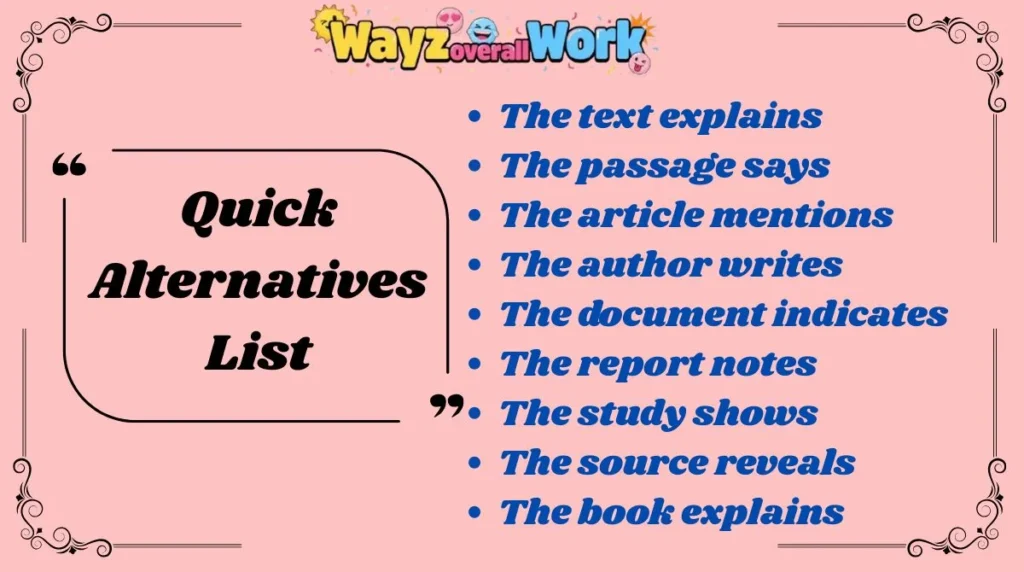
- The text explains
- The passage says
- The article mentions
- The author writes
- The document indicates
- The report notes
- The study shows
- The source reveals
- The book explains
- The evidence suggests
- The paper argues
- The article points out
- The document outlines
- The report confirms
- The passage highlights
- The research demonstrates
- The author emphasizes
- The text reveals
The Text Explains
Meaning: It gives information clearly.
Explanation: This alternative focuses on explaining an idea rather than simply stating it.
Grammar Note: Verb phrase.
Example Sentence: The text explains how volcanoes form.
Best Use: Academic writing, classrooms, reports
Worst Use: When the document only gives a brief fact.
Tone: Formal
Level: Beginner
Similarity Score: 9.5/10
Replaceability Tip: Choose this when the writing teaches or clarifies something.
The Passage Says
Meaning: The passage tells the reader something.
Explanation: A simple and natural alternative used by students and teachers.
Grammar Note: Verb phrase.
Example Sentence: The passage says that honesty builds trust.
Best Use: School assignments
Worst Use: Highly formal legal documents
Tone: Neutral
Level: Beginner
Similarity Score: 10/10
Replaceability Tip: Great for everyday academic writing.
The Article Mentions
Meaning: It briefly refers to something.
Explanation: Best when information is included but not discussed in detail.
Grammar Note: Verb phrase.
Example Sentence: The article mentions several health benefits.
Best Use: News articles
Worst Use: When the source gives detailed explanations.
Tone: Neutral
Level: Beginner
Similarity Score: 8.5/10
Replaceability Tip: Use when the information is only briefly included.
The Author Writes
Meaning: The author says something in writing.
Explanation: Focuses on the writer instead of the document.
Grammar Note: Verb phrase.
Example Sentence: The author writes that courage comes from practice.
Best Use: Literature essays
Worst Use: Technical manuals
Tone: Neutral
Level: Beginner
Similarity Score: 8/10
Replaceability Tip: Perfect when discussing an author’s ideas.
The Document Indicates
Meaning: The document points toward a fact.
Explanation: Sounds professional and common in business settings.
Grammar Note: Formal verb phrase.
Example Sentence: The document indicates that payment is due next week.
Best Use: Workplace
Worst Use: Casual chats
Tone: Professional
Level: Intermediate
Similarity Score: 9/10
Replaceability Tip: Ideal for contracts and reports.
The Report Notes
Meaning: The report records important information.
Explanation: Frequently used in business and research writing.
Grammar Note: Verb phrase.
Example Sentence: The report notes a rise in customer satisfaction.
Best Use: Reports
Worst Use: Personal conversations
Tone: Professional
Level: Intermediate
Similarity Score: 9/10
Replaceability Tip: Excellent for statistics and findings.
The Study Shows
Meaning: Research proves or demonstrates something.
Explanation: Common in scientific and academic writing.
Grammar Note: Verb phrase.
Example Sentence: The study shows that exercise improves memory.
Best Use: Research
Worst Use: Fiction analysis
Tone: Formal
Level: Intermediate
Similarity Score: 7.5/10
Replaceability Tip: Use when discussing research results.
The Source Reveals
Meaning: The source uncovers important information.
Explanation: Often suggests new or surprising details.
Grammar Note: Verb phrase.
Example Sentence: The source reveals new historical evidence.
Best Use: Journalism
Worst Use: Basic school summaries
Tone: Strong
Level: Advanced
Similarity Score: 7/10
Replaceability Tip: Best for important discoveries.
The Book Explains
Meaning: The book teaches or clarifies something.
Explanation: Natural when referring to textbooks or nonfiction.
Grammar Note: Verb phrase.
Example Sentence: The book explains the causes of inflation.
Best Use: Education
Worst Use: News reports
Tone: Neutral
Level: Beginner
Similarity Score: 9/10
Replaceability Tip: Choose when the source educates readers.
The Evidence Suggests
Meaning: The available information points toward a conclusion.
Explanation: Softer than states because it allows uncertainty.
Grammar Note: Formal phrase.
Example Sentence: The evidence suggests that sleep improves learning.
Best Use: Research papers
Worst Use: Facts that are already certain.
Tone: Soft
Level: Advanced
Similarity Score: 6.5/10
Replaceability Tip: Excellent when discussing probable conclusions.
The Paper Argues
Meaning: The paper presents a viewpoint.
Explanation: Common in university essays and research analysis.
Grammar Note: Academic verb phrase.
Example Sentence: The paper argues that education should be free.
Best Use: Academic writing
Worst Use: Instruction manuals
Tone: Formal
Level: Advanced
Similarity Score: 7/10
Replaceability Tip: Use when discussing opinions rather than facts.
The Article Points Out
Meaning: It draws attention to something important.
Explanation: Highlights a specific idea.
Grammar Note: Phrasal verb.
Example Sentence: The article points out several common mistakes.
Best Use: Blogs and articles
Worst Use: Legal documents
Tone: Friendly
Level: Intermediate
Similarity Score: 8/10
Replaceability Tip: Good when emphasizing key information.
The Document Outlines
Meaning: It gives the main points.
Explanation: Often used for plans, policies, and proposals.
Grammar Note: Formal verb phrase.
Example Sentence: The document outlines the hiring process.
Best Use: Business writing
Worst Use: Casual texting
Tone: Professional
Level: Intermediate
Similarity Score: 7.5/10
Replaceability Tip: Use when summarizing structure or procedures.
The Report Confirms
Meaning: It verifies information.
Explanation: Strong wording that shows certainty.
Grammar Note: Verb phrase.
Example Sentence: The report confirms the project’s success.
Best Use: Official reports
Worst Use: Uncertain situations
Tone: Strong
Level: Intermediate
Similarity Score: 7.5/10
Replaceability Tip: Choose this only when evidence is definite.
The Author Emphasizes
Meaning: The writer gives special importance to an idea.
Explanation: Focuses on what the writer considers significant.
Grammar Note: Verb phrase.
Example Sentence: The author emphasizes the value of teamwork.
Best Use: Literature and essays
Worst Use: Simple factual summaries
Tone: Formal
Level: Intermediate
Similarity Score: 7/10
Replaceability Tip: Use when highlighting key ideas rather than general statements.
Mini Dialogue Examples
Formal Conversation
Student: What does the chapter say about leadership?
Teacher: The text states that effective leaders communicate clearly.
Informal Conversation
Alex: Did you read the article?
Jamie: Yeah. The article says eating more vegetables improves health.
Business Email Example
Subject: Policy Update
Dear Team,
The document indicates that the revised travel policy will take effect next Monday. Please review the attached guidelines before submitting your next expense claim.
Kind regards,
Sarah
Mistakes to Avoid
- Using states when the source only suggests an idea.
- Repeating the text states in every paragraph.
- Saying the text tells in formal academic writing when states or explains is more appropriate.
- Using confirms without strong evidence.
- Choosing argues for documents that simply report facts.
- Mixing formal and informal expressions in the same essay.
- Using mentions when the source actually explains the topic in detail.
Cultural & Tone Tips
Native English speakers see “the text states” as a clear, professional, and neutral expression.
UK English
British English often prefers formal academic wording such as the passage states, the report notes, and the document indicates.
US English
American English frequently uses both the text states and the article says. In classrooms, the author explains is also very common.
Casual Social English
Outside school or work, native speakers usually simplify the phrase.
Instead of saying:
“The text states…”
They often say:
“The article says…”
or
“It says…”
This sounds more natural in everyday conversation.
Comparison Table
| Phrase | Tone | Best Context | Professional Level | Example |
|---|---|---|---|---|
| The passage says | Neutral | School | Medium | The passage says honesty matters. |
| The text explains | Formal | Education | High | The text explains the process. |
| The document indicates | Professional | Business | Very High | The document indicates new rules. |
| The report notes | Professional | Reports | High | The report notes higher sales. |
| The article mentions | Neutral | News | Medium | The article mentions new research. |
| The paper argues | Formal | University | High | The paper argues for reform. |
| The author emphasizes | Formal | Literature | High | The author emphasizes kindness. |
FAQs
Is “the text states” rude?
No. It is polite and professional.
Is it okay in emails?
Yes. It works well in formal and business emails.
What is the most formal alternative?
The document indicates is among the most formal options.
What is the most polite alternative?
The report notes sounds polite and professional.
What should beginners use?
The passage says is simple and easy.
Which alternative is best for essays?
The text explains, the author writes, and the paper argues are excellent choices.
Conclusion
Using different ways to say “the text states” makes your English more natural, professional, and engaging. While the original phrase is correct, repeating it too often can weaken your writing.
Learning alternatives such as the document indicates, the report notes, the author emphasizes, and the article mentions helps you communicate more clearly in essays, emails, reports, and everyday conversations.
The best expression always depends on your audience, purpose, and tone. Practice using these alternatives in real writing and conversations.
Over time, they will become a natural part of your vocabulary and help you write with greater confidence and fluency.

Rashmeer is a passionate writer and content creator dedicated to delivering clear, engaging, and reliable information. With a focus on quality and authenticity, Rashmeer creates content that informs, inspires, and helps readers discover practical ideas and fresh perspectives.