
“As you can see” is a common English phrase used to draw someone’s attention to something that is visible, obvious, or easy to understand.
People often use it when explaining a chart, giving a presentation, writing an email, or pointing out facts in a conversation.
Although the phrase is clear and natural, using it too often can make your writing and speaking sound repetitive. Learning other ways to say “as you can see” helps you sound more fluent, confident, and professional.
The right expression can also match the situation better. Some alternatives work well in business emails, while others fit casual conversations or academic writing.
Choosing the right words improves clarity and creates the right tone. It also shows that you have a strong command of English.
Example:
Formal: It is evident that sales increased during the final quarter.
Informal: You can tell sales really picked up at the end of the year.
What Does “As You Can See” Mean?
“As you can see” means that the information is already visible, obvious, or easy for the listener or reader to notice. It is often used to guide someone’s attention toward evidence, facts, images, charts, or situations.
Grammar Form
It is a fixed expression (phrase) commonly used as an introductory expression before making a point.
Similar Expressions
- Clearly
- As shown
- It is evident
- As illustrated
- You can tell
- Obviously
- As demonstrated
Opposite Expressions
- It is difficult to see
- It is unclear
- It is not obvious
- This may not be apparent
- It remains uncertain
Example Sentences
- As you can see, the project finished ahead of schedule.
- As you can see, the map highlights the safest route.
When to Use “As You Can See”
Spoken English
Use it when pointing out something another person can easily notice.
Example:
“As you can see, the restaurant is already full.”
Business English
It works well when discussing reports, presentations, graphs, or company results.
Example:
“As you can see, our profits increased this quarter.”
Emails and Messages
Use it when referring to attached files, screenshots, or previous information.
Example:
“As you can see in the attached document, all tasks have been completed.”
Social Media
It helps explain photos, videos, or progress updates.
Example:
“As you can see, the garden looks much healthier now.”
Academic Writing
It is acceptable but should not be overused. More formal alternatives often sound stronger.
Example:
“As illustrated in Figure 2, the results support the hypothesis.”
Professional Meetings
Use it when explaining slides, charts, or performance data.
Example:
“As you can see, customer satisfaction has improved significantly.”
Is “As You Can See” Polite or Professional?
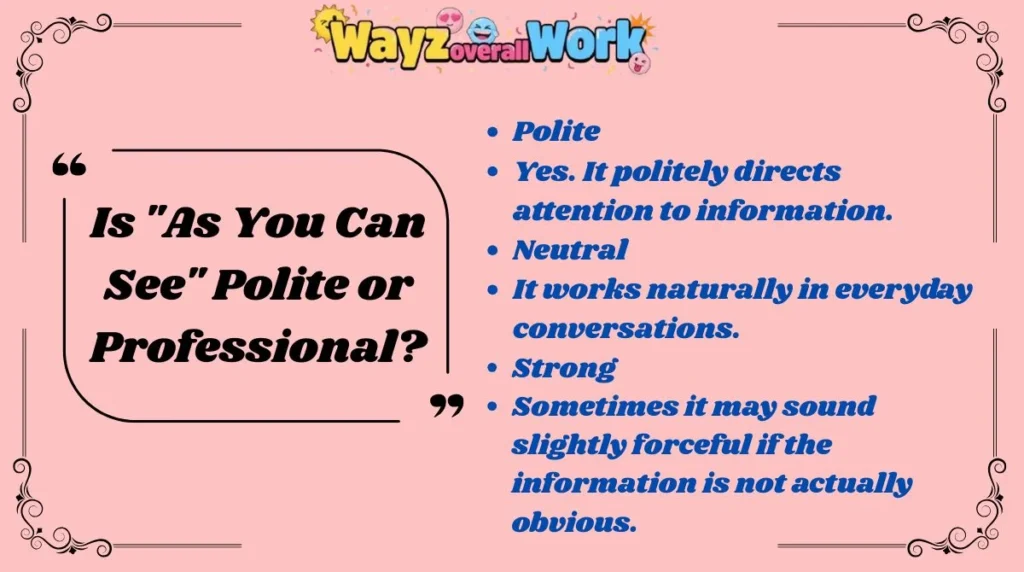
“As you can see” is generally polite and professional. However, its tone depends on the situation.
Polite
Yes. It politely directs attention to information.
Neutral
It works naturally in everyday conversations.
Strong
Sometimes it may sound slightly forceful if the information is not actually obvious.
Soft
You can soften it by saying:
- As you may notice
- As shown below
- It appears that
Formal vs. Informal
Formal
- As illustrated
- As demonstrated
- It is evident that
- As indicated
Informal
- You can tell
- Look
- See?
- Notice this
Etiquette Tip
Better for workplace: As illustrated, As shown below, It is evident that.
Avoid in corporate emails: Repeating “As you can see” several times in the same message.
Pros & Cons of Using “As You Can See”
✔ Pros
- Easy to understand.
- Natural in speech.
- Suitable for presentations.
- Works in emails.
- Helps direct attention.
- Common among native speakers.
✘ Cons
- Can become repetitive.
- Sometimes sounds too obvious.
- Less effective in academic writing.
- Not always the strongest professional choice.
- May sound slightly patronizing if overused.
Quick Alternatives List
- Clearly
- As shown
- As illustrated
- As demonstrated
- As indicated
- As presented
- It is evident that
- It is apparent that
- You can tell
- Notice that
- Observe that
- As reflected in
- As outlined
- As highlighted
- As displayed
- As revealed
- As explained
- As mentioned earlier
- As noted
- From this, it is clear
Clearly
Meaning:
Something is obvious or easy to understand.
Explanation:
Clearly is one of the most natural replacements for “as you can see.” It sounds confident and direct. It is common in reports, presentations, essays, and everyday conversations.
Grammar Note:
Adverb.
Example Sentence:
Clearly, the new strategy has improved customer satisfaction.
Best Use:
Formal, workplace, academic writing, presentations.
Worst Use:
Avoid using it when the evidence is uncertain.
Tone:
Professional.
Level:
Beginner.
Similarity Score:
10/10
Replaceability Tip:
Use clearly when the facts are easy for everyone to understand.
As Shown
Meaning:
The information is visible in a chart, image, or document.
Explanation:
This phrase is common in reports, presentations, research papers, and business documents. It directs readers to visual evidence.
Grammar Note:
Formal introductory phrase.
Example Sentence:
As shown in the graph, sales increased every month.
Best Use:
Reports, presentations, academic writing.
Worst Use:
Casual conversations.
Tone:
Formal.
Level:
Beginner.
Similarity Score:
10/10
Replaceability Tip:
Choose this phrase whenever you refer to graphs, tables, or figures.
As Illustrated
Meaning:
The evidence is presented through an illustration, chart, or example.
Explanation:
This alternative sounds more polished than “as you can see.” It is widely used in research papers, textbooks, and business presentations.
Grammar Note:
Formal phrase.
Example Sentence:
As illustrated in Figure 4, customer engagement increased.
Best Use:
Academic writing, reports, workplace.
Worst Use:
Text messages.
Tone:
Formal.
Level:
Intermediate.
Similarity Score:
9.5/10
Replaceability Tip:
Use this phrase when referring to diagrams or visual examples.
It Is Evident That
Meaning:
Something is very clear based on the available evidence.
Explanation:
This expression sounds formal and authoritative. It fits academic papers, legal writing, and professional reports.
Grammar Note:
Formal statement.
Example Sentence:
It is evident that customer demand continues to grow.
Best Use:
Academic, professional, workplace.
Worst Use:
Friendly chats.
Tone:
Formal.
Level:
Advanced.
Similarity Score:
9/10
Replaceability Tip:
Use this phrase when discussing facts supported by strong evidence.
It Is Apparent That
Meaning:
Something appears obvious after examining the facts.
Explanation:
This phrase is slightly softer than “it is evident that.” It is excellent for professional reports and business writing.
Grammar Note:
Formal phrase.
Example Sentence:
It is apparent that the team exceeded expectations.
Best Use:
Professional writing, reports, meetings.
Worst Use:
Very casual conversations.
Tone:
Professional.
Level:
Intermediate.
Similarity Score:
9/10
Replaceability Tip:
Choose this expression when you want to sound formal without being overly strong.
As Demonstrated
Meaning:
The evidence proves the statement.
Explanation:
This phrase emphasizes proof rather than observation. It is common in scientific papers, business presentations, and training materials.
Grammar Note:
Formal phrase.
Example Sentence:
As demonstrated during the experiment, the method is highly effective.
Best Use:
Research, workplace, education.
Worst Use:
Everyday chats.
Tone:
Professional.
Level:
Advanced.
Similarity Score:
9/10
Replaceability Tip:
Use this phrase when referring to tested or proven results.
As Indicated
Meaning:
The information points to a particular conclusion.
Explanation:
This expression is common in reports, official documents, and business communication. It focuses on information that supports a conclusion.
Grammar Note:
Formal phrase.
Example Sentence:
As indicated in the report, customer retention has improved.
Best Use:
Reports, business emails, presentations.
Worst Use:
Casual conversations.
Tone:
Formal.
Level:
Intermediate.
Similarity Score:
9/10
Replaceability Tip:
Use this phrase when referring to findings in a document or report.
Notice That
Meaning:
Pay attention to something important.
Explanation:
This phrase invites the listener or reader to observe a specific detail. It is friendly and instructional.
Grammar Note:
Imperative phrase.
Example Sentence:
Notice that every answer follows the same pattern.
Best Use:
Teaching, presentations, tutorials.
Worst Use:
Formal legal documents.
Tone:
Friendly.
Level:
Beginner.
Similarity Score:
8.5/10
Replaceability Tip:
Choose this phrase when guiding someone’s attention during explanations.
Observe That
Meaning:
Look carefully and recognize an important fact.
Explanation:
This alternative sounds more formal than “notice that.” It is often used in academic and scientific contexts.
Grammar Note:
Verb phrase.
Example Sentence:
Observe that the reaction becomes faster as the temperature increases.
Best Use:
Education, research, presentations.
Worst Use:
Casual texting.
Tone:
Formal.
Level:
Intermediate.
Similarity Score:
8.5/10
Replaceability Tip:
Use this expression when encouraging careful observation.
You Can Tell
Meaning:
It is easy to recognize something.
Explanation:
This informal alternative is common in everyday English. It feels natural in conversations and friendly writing.
Grammar Note:
Informal expression.
Example Sentence:
You can tell everyone enjoyed the event.
Best Use:
Conversations, social media, text messages.
Worst Use:
Formal reports or business documents.
Tone:
Friendly.
Level:
Beginner.
Similarity Score:
8/10
Replaceability Tip:
Use this phrase when speaking casually with friends or family.
As Highlighted
Meaning:
Something important has been emphasized or brought to your attention.
Explanation:
As highlighted is a polished and professional alternative to “as you can see.” It tells readers or listeners that a key point has already been emphasized in a report, presentation, or discussion.
Grammar Note:
Formal introductory phrase.
Example Sentence:
As highlighted in the quarterly report, customer satisfaction reached a record high.
Best Use:
Business reports, presentations, emails, workplace.
Worst Use:
Casual text messages.
Tone:
Professional.
Level:
Intermediate.
Similarity Score:
9/10
Replaceability Tip:
Use this phrase when referring to an important point that has already been emphasized.
As Displayed
Meaning:
The information is shown on a screen, chart, table, or document.
Explanation:
This phrase is common in presentations and reports where visual information supports your point. It sounds clear and professional.
Grammar Note:
Formal phrase.
Example Sentence:
As displayed on the dashboard, website traffic has increased steadily.
Best Use:
Presentations, reports, data analysis.
Worst Use:
Friendly conversations.
Tone:
Formal.
Level:
Intermediate.
Similarity Score:
9/10
Replaceability Tip:
Choose this phrase when referring to information that is visually presented.
As Revealed
Meaning:
The information shows or uncovers something important.
Explanation:
This alternative emphasizes discovery. It is often used in research, surveys, reports, and news articles.
Grammar Note:
Formal phrase.
Example Sentence:
As revealed by the survey, most customers prefer online shopping.
Best Use:
Research papers, reports, business writing.
Worst Use:
Everyday conversation.
Tone:
Professional.
Level:
Advanced.
Similarity Score:
8.5/10
Replaceability Tip:
Use it when new evidence or findings support your statement.
As Reflected In
Meaning:
The information is shown through data, results, or performance.
Explanation:
This phrase is common in finance, business, and academic writing. It suggests that the evidence reflects a trend or outcome.
Grammar Note:
Formal prepositional phrase.
Example Sentence:
As reflected in the annual report, revenue grew by 18%.
Best Use:
Financial reports, academic writing, business documents.
Worst Use:
Casual speech.
Tone:
Formal.
Level:
Advanced.
Similarity Score:
8.5/10
Replaceability Tip:
Use this phrase when discussing data or measurable results.
As Outlined
Meaning:
The information has already been organized or explained.
Explanation:
This expression works well when referring to plans, proposals, guidelines, or procedures.
Grammar Note:
Formal phrase.
Example Sentence:
As outlined in the proposal, the project will be completed in three phases.
Best Use:
Business writing, contracts, reports.
Worst Use:
Informal chats.
Tone:
Professional.
Level:
Intermediate.
Similarity Score:
8/10
Replaceability Tip:
Use it when referring to structured documents or plans.
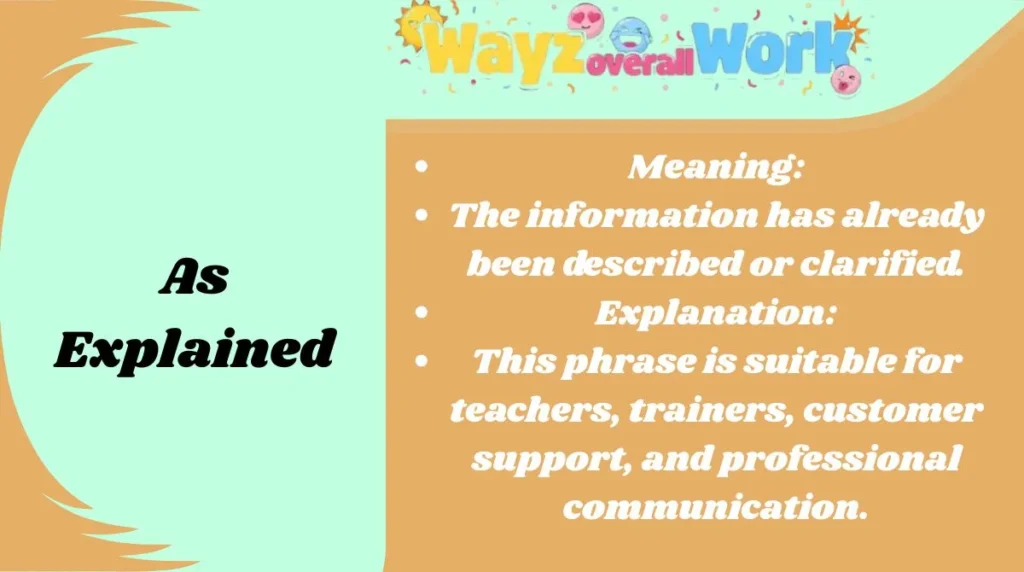
As Explained
Meaning:
The information has already been described or clarified.
Explanation:
This phrase is suitable for teachers, trainers, customer support, and professional communication.
Grammar Note:
Formal introductory phrase.
Example Sentence:
As explained during today’s meeting, the launch date has changed.
Best Use:
Emails, meetings, education.
Worst Use:
When no previous explanation exists.
Tone:
Neutral.
Level:
Beginner.
Similarity Score:
8/10
Replaceability Tip:
Use this phrase to remind readers of an earlier explanation.
As Mentioned Earlier
Meaning:
This information was shared previously.
Explanation:
Instead of pointing to something visible, this phrase reminds people about an earlier statement.
Grammar Note:
Introductory phrase.
Example Sentence:
As mentioned earlier, the deadline is Friday.
Best Use:
Emails, meetings, reports.
Worst Use:
When introducing new information.
Tone:
Professional.
Level:
Beginner.
Similarity Score:
7.5/10
Replaceability Tip:
Choose this phrase when referring back to earlier information.
As Noted
Meaning:
Something has already been written or pointed out.
Explanation:
This concise phrase is common in academic and professional writing. It sounds formal without being too complex.
Grammar Note:
Formal phrase.
Example Sentence:
As noted in the report, employee retention improved significantly.
Best Use:
Academic writing, reports, workplace.
Worst Use:
Casual conversations.
Tone:
Formal.
Level:
Intermediate.
Similarity Score:
8.5/10
Replaceability Tip:
Use it when referring to previously documented information.
From This, It Is Clear
Meaning:
The evidence leads to an obvious conclusion.
Explanation:
This expression connects evidence to a conclusion. It is common in essays, reports, and presentations.
Grammar Note:
Formal transition phrase.
Example Sentence:
From this, it is clear that customer demand continues to grow.
Best Use:
Academic writing, reports, presentations.
Worst Use:
Text messages.
Tone:
Formal.
Level:
Intermediate.
Similarity Score:
8.5/10
Replaceability Tip:
Use this phrase when drawing conclusions from evidence.
Obviously
Meaning:
Something is very easy to understand.
Explanation:
Obviously is a direct replacement, but it should be used carefully. Sometimes it can make the listener feel that they should have known the answer already.
Grammar Note:
Adverb.
Example Sentence:
Obviously, the new system performs much faster than the old one.
Best Use:
Friendly conversations, informal presentations.
Worst Use:
Customer emails or situations where the fact may not be obvious.
Tone:
Strong.
Level:
Beginner.
Similarity Score:
8/10
Replaceability Tip:
Avoid using obviously if it might sound dismissive or rude.
Mini Dialogue Examples
Formal Dialogue
Manager: Please review the latest sales report.
Employee: Certainly.
Manager: As illustrated in the graph, sales increased by 22% during the last quarter.
Employee: The trend is very encouraging.
Informal Dialogue
Emma: Did you repaint your living room?
Jake: Yes.
Emma: You can tell it looks much brighter now.
Jake: Thanks! I’m really happy with the result.
Business Email Example
Subject: Monthly Performance Update
Hello Team,
As highlighted in the attached report, our customer satisfaction score improved by 12% this month. Thank you for your continued hard work and dedication.
Best regards,
Sarah
Mistakes to Avoid
Many English learners make small mistakes when using “as you can see” and similar expressions. Here are some common ones.
- Using “as you can see” when nothing is actually visible.
- Repeating the phrase several times in one email or presentation.
- Using informal alternatives like “you can tell” in academic papers.
- Writing “obviously” in situations where the reader may disagree.
- Mixing formal and informal language in the same paragraph.
- Using “as mentioned earlier” before introducing new information.
- Choosing a very formal phrase during casual conversations with friends.
Cultural & Tone Tips
Native English speakers use “as you can see” naturally, but they also vary their language depending on the setting.
UK English
British speakers often prefer softer and less direct expressions such as:
- As shown
- It appears that
- As illustrated
These phrases sound polite and professional.
US English
American English commonly uses:
- Clearly
- As shown
- You can tell
- Obviously
The tone is often more direct, especially in presentations and business meetings.
Casual Social English
Friends usually avoid formal expressions. Instead, they say:
- You can tell
- Look at this
- See?
- Check this out
- Notice how…
These expressions sound natural in everyday conversations and social media posts.
Comparison Table
| Phrase | Tone | Best Context | Professional Level | Example |
|---|---|---|---|---|
| Clearly | Professional | Reports, presentations | High | Clearly, the results improved. |
| As Shown | Formal | Charts, reports | Very High | As shown in Figure 2… |
| As Illustrated | Formal | Academic writing | Very High | As illustrated in the diagram… |
| It Is Evident That | Formal | Research, business | Excellent | It is evident that profits increased. |
| As Highlighted | Professional | Emails, reports | High | As highlighted in the report… |
| As Demonstrated | Formal | Scientific writing | Excellent | As demonstrated by the experiment… |
| You Can Tell | Friendly | Everyday conversation | Low | You can tell they’re excited. |
Frequently Asked Questions
Is “as you can see” rude?
No. It is generally polite. However, using it too often or when something is not actually obvious may sound slightly patronizing.
Is it okay to use “as you can see” in emails?
Yes. It works well in emails, especially when referring to attachments, screenshots, or reports. For a more polished tone, consider using as shown or as highlighted.
What is the most formal alternative?
Some of the most formal choices include as illustrated, as demonstrated, it is evident that, and as indicated.
What is the most polite alternative?
As shown, as highlighted, and it appears that are polite and professional without sounding too direct.
Which alternative is best for beginners?
Beginners should use simple expressions such as clearly, as shown, notice that, and you can tell because they are easy to understand and use correctly.
Should I avoid repeating “as you can see”?
Yes. Repeating the same phrase makes your writing sound repetitive. Using a variety of alternatives improves fluency, professionalism, and readability.
Conclusion
Using different ways to say “as you can see” makes your English more natural, engaging, and effective.
While the original phrase is clear and widely accepted, choosing the right alternative helps you match the tone of your conversation, email, presentation, or academic writing.
Formal expressions such as as illustrated and it is evident that add professionalism, while friendly options like you can tell make everyday conversations feel more relaxed.
Practice these alternatives in real situations, and you’ll build stronger communication skills, expand your vocabulary, and speak or write with greater confidence.

Rashmeer is a passionate writer and content creator dedicated to delivering clear, engaging, and reliable information. With a focus on quality and authenticity, Rashmeer creates content that informs, inspires, and helps readers discover practical ideas and fresh perspectives.