
Good communication skills help people share ideas clearly, listen carefully, and build strong relationships.
Whether you are talking with friends, writing an email, attending a job interview, or giving a presentation, communication plays an important role in everyday life.
Using different ways to express good communication skills makes your English sound more natural and professional.
Instead of repeating the same phrase, you can choose words that better match the situation. This improves your writing, speaking, and overall confidence.
It also helps you create a stronger impression in business, academic, and social settings.
For example:
- Formal: She has excellent interpersonal skills.
- Informal: She’s great at talking to people.
Both sentences express a similar idea, but the tone is different. Learning these alternatives will help you communicate with greater clarity and confidence.
What Does “Good Communication Skills” Mean?
Good communication skills means the ability to express thoughts, ideas, and information clearly while also listening carefully and understanding others. A person with good communication skills can speak, write, and interact effectively in different situations.
Grammar Form
Good communication skills is a noun phrase.
Similar Expressions
- Effective communication
- Strong communication abilities
- Excellent interpersonal skills
- Clear communicator
- Articulate speaker
- Strong verbal skills
Opposite Expressions
- Poor communication skills
- Weak communication abilities
- Ineffective communication
- Difficulty expressing ideas
- Poor listener
Example Sentences
- She has good communication skills and works well with clients.
- Employees with good communication skills often become better team leaders.
When to Use “Good Communication Skills”
Spoken English
Use the phrase when talking about someone’s ability to explain ideas, listen, or work with others.
Example:
“He has good communication skills, so everyone understands his instructions.”
Business English
This phrase is common in resumes, interviews, performance reviews, and workplace conversations.
Example:
“We are looking for candidates with good communication skills and teamwork abilities.”
Emails and Messages
It fits professional emails when discussing employees, colleagues, or job applicants.
Example:
“Your good communication skills have helped improve client relationships.”
Social Media
People often use it to praise speakers, teachers, creators, or public figures.
Example:
“She has amazing communication skills during her live sessions.”
Academic Writing
Students can use it in essays about leadership, teamwork, education, or career development.
Example:
“Good communication skills are essential for successful collaboration.”
Professional Meetings
Managers frequently use this phrase during evaluations, interviews, and presentations.
Example:
“His good communication skills helped resolve the issue quickly.”
Is “Good Communication Skills” Polite or Professional?
Yes. Good communication skills is both polite and professional. It is one of the safest expressions to use in almost every situation.
Polite
Suitable when complimenting someone respectfully.
Neutral
Works in everyday conversations without sounding too formal.
Strong
It gives positive feedback but does not exaggerate.
Soft
It sounds encouraging and supportive.
Formal vs. Informal
- Formal: Good communication skills, effective communication, excellent interpersonal skills
- Informal: Great at talking to people, easy to talk to
Etiquette Tip: The phrase is excellent for resumes, job interviews, business meetings, and corporate emails because it sounds professional and widely accepted.
Pros & Cons of Using “Good Communication Skills”
✔ Pros
- Easy for everyone to understand
- Suitable for professional writing
- Common in resumes and interviews
- Works in business and academic settings
- Sounds respectful and positive
- Appropriate in formal and informal situations
✘ Cons
- Used very frequently
- Can sound generic on a resume
- Does not explain specific communication strengths
- Less memorable than stronger alternatives
- May not highlight advanced abilities like negotiation or presentation skills
Quick Alternatives List
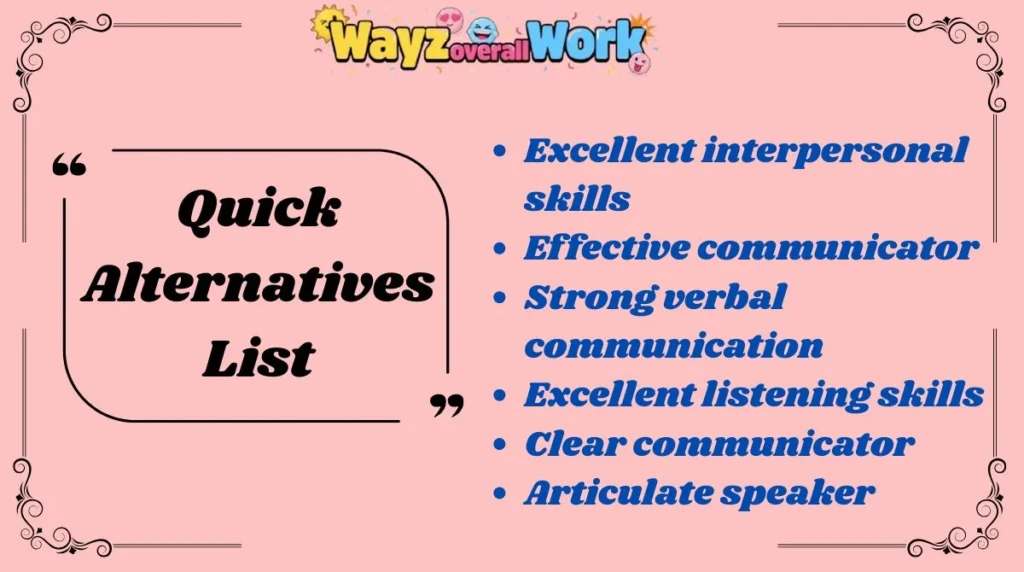
- Excellent interpersonal skills
- Effective communicator
- Strong verbal communication
- Excellent listening skills
- Clear communicator
- Articulate speaker
- Strong presentation skills
- Professional communicator
- Strong people skills
- Outstanding conversational skills
- Confident communicator
- Persuasive communicator
- Exceptional collaboration skills
- Able to express ideas clearly
- Excellent relationship-building skills
- Skilled in verbal communication
- Strong written communication
- Excellent public speaking skills
Excellent Interpersonal Skills
Meaning:
The ability to communicate and build positive relationships with other people.
Explanation:
This phrase focuses on communication as well as teamwork, cooperation, empathy, and relationship-building. Employers often use it when describing people who work well with colleagues and customers.
Grammar Note:
Noun phrase.
Example Sentence:
She has excellent interpersonal skills and creates strong relationships with clients.
Best Use:
Formal, Workplace, Resume, Interview, Business Email
Worst Use:
Very casual conversations with friends.
Tone:
Professional
Level:
Intermediate
Similarity Score:
10/10
Replaceability Tip:
Use this instead of good communication skills when discussing teamwork or customer service.
Effective Communicator
Meaning:
Someone who shares ideas clearly and understands others.
Explanation:
This is one of the strongest professional alternatives. It highlights clarity, confidence, and successful communication rather than simply having communication skills.
Grammar Note:
Noun phrase.
Example Sentence:
He is an effective communicator who explains complex topics simply.
Best Use:
Resume, LinkedIn, Workplace, Interview
Worst Use:
Very informal chats.
Tone:
Professional
Level:
Intermediate
Similarity Score:
10/10
Replaceability Tip:
Choose this when describing a person’s overall communication ability.
Strong Verbal Communication Skills
Meaning:
The ability to speak clearly and confidently.
Explanation:
This phrase focuses specifically on spoken communication rather than writing.
Grammar Note:
Noun phrase.
Example Sentence:
Applicants should demonstrate strong verbal communication skills during the interview.
Best Use:
Job descriptions, Interviews, Workplace
Worst Use:
Text messages or casual social media posts.
Tone:
Formal
Level:
Beginner
Similarity Score:
9.5/10
Replaceability Tip:
Use this when speaking ability is more important than writing.
Clear Communicator
Meaning:
Someone who explains ideas in a simple and understandable way.
Explanation:
This phrase emphasizes clarity rather than confidence or persuasion.
Grammar Note:
Noun phrase.
Example Sentence:
She is a clear communicator who avoids unnecessary confusion.
Best Use:
Business, Leadership, Education
Worst Use:
Very casual conversations.
Tone:
Neutral
Level:
Beginner
Similarity Score:
9/10
Replaceability Tip:
Use this when you want to highlight simplicity and clarity.
Articulate Speaker
Meaning:
Someone who speaks fluently and expresses ideas well.
Explanation:
An articulate speaker uses precise words and communicates with confidence. This phrase is common in professional and academic settings.
Grammar Note:
Noun phrase.
Example Sentence:
The manager is an articulate speaker who inspires the entire team.
Best Use:
Presentations, Interviews, Academic Writing
Worst Use:
Describing written communication only.
Tone:
Professional
Level:
Advanced
Similarity Score:
8.5/10
Replaceability Tip:
Use this when discussing public speaking or presentations.
Strong People Skills
Meaning:
The ability to communicate and interact well with others.
Explanation:
People skills include communication, empathy, teamwork, patience, and relationship-building.
Grammar Note:
Noun phrase.
Example Sentence:
Customer service representatives need strong people skills.
Best Use:
Customer service, Sales, Healthcare
Worst Use:
Academic essays requiring formal language.
Tone:
Friendly
Level:
Beginner
Similarity Score:
8.5/10
Replaceability Tip:
Use this when discussing working with customers or teams.
Excellent Listening Skills
Meaning:
The ability to listen carefully and understand others.
Explanation:
Communication is not only about speaking. Good listeners understand ideas before responding, making this phrase valuable in leadership and teamwork.
Grammar Note:
Noun phrase.
Example Sentence:
A good manager demonstrates excellent listening skills during meetings.
Best Use:
Leadership, Workplace, Interviews
Worst Use:
When describing only speaking ability.
Tone:
Professional
Level:
Beginner
Similarity Score:
7.5/10
Replaceability Tip:
Choose this when active listening is the main strength.
Able to Express Ideas Clearly
Meaning:
Someone who explains thoughts in an easy-to-understand way.
Explanation:
This phrase is simple, natural, and useful for both spoken and written English. It emphasizes clarity over style or persuasion.
Grammar Note:
Verb phrase.
Example Sentence:
She is able to express ideas clearly during client presentations.
Best Use:
Academic Writing, Workplace, Emails
Worst Use:
Very short resume bullet points where concise wording is preferred.
Tone:
Neutral
Level:
Beginner
Similarity Score:
9/10
Replaceability Tip:
Use this when clarity is more important than advanced vocabulary.
Professional Communicator
Meaning:
A person who communicates clearly, respectfully, and effectively in a professional setting.
Explanation:
This phrase highlights workplace communication. It suggests that someone can interact with clients, coworkers, and managers in a confident and appropriate way. It is commonly used in resumes, LinkedIn profiles, and performance reviews.
Grammar Note:
Noun phrase.
Example Sentence:
She is a professional communicator who builds trust with clients and colleagues.
Best Use:
Workplace, Resume, Business Email, LinkedIn
Worst Use:
Casual conversations with friends.
Tone:
Professional
Level:
Intermediate
Similarity Score (0–10):
9.5/10
Replaceability Tip:
Use this when describing workplace communication rather than everyday conversations.
Confident Communicator
Meaning:
Someone who speaks with confidence and clarity.
Explanation:
A confident communicator expresses ideas without hesitation while remaining respectful. This phrase is often used for leaders, presenters, and job candidates.
Grammar Note:
Noun phrase.
Example Sentence:
He is a confident communicator who handles meetings with ease.
Best Use:
Interviews, Leadership, Presentations, Workplace
Worst Use:
Situations where confidence may sound like arrogance.
Tone:
Professional
Level:
Intermediate
Similarity Score (0–10):
9/10
Replaceability Tip:
Choose this phrase when confidence is one of the person’s greatest strengths.
Persuasive Communicator
Meaning:
Someone who can influence others through effective communication.
Explanation:
This phrase emphasizes the ability to convince people using clear arguments and logical reasoning. It is especially useful in sales, marketing, leadership, and public speaking.
Grammar Note:
Noun phrase.
Example Sentence:
The sales manager is a persuasive communicator who builds customer confidence.
Best Use:
Sales, Marketing, Business, Leadership
Worst Use:
Describing someone who only shares information without trying to influence others.
Tone:
Professional
Level:
Advanced
Similarity Score (0–10):
8.5/10
Replaceability Tip:
Use this when persuasion is more important than general communication.
Strong Written Communication Skills
Meaning:
The ability to write clearly and professionally.
Explanation:
Some jobs require excellent writing more than speaking. This phrase highlights emails, reports, proposals, and other written communication.
Grammar Note:
Noun phrase.
Example Sentence:
The position requires strong written communication skills and attention to detail.
Best Use:
Resume, Business Writing, Academic Writing
Worst Use:
When discussing public speaking.
Tone:
Formal
Level:
Beginner
Similarity Score (0–10):
8/10
Replaceability Tip:
Use this when writing ability is the main focus.
Strong Presentation Skills
Meaning:
The ability to present ideas confidently to an audience.
Explanation:
Presentation skills include organizing information, speaking clearly, and engaging listeners. This phrase is common in business and education.
Grammar Note:
Noun phrase.
Example Sentence:
She has strong presentation skills and delivers engaging workshops.
Best Use:
Business, Training, Education, Conferences
Worst Use:
Casual everyday conversations.
Tone:
Professional
Level:
Intermediate
Similarity Score (0–10):
8/10
Replaceability Tip:
Choose this when discussing speaking in front of groups.
Exceptional Collaboration Skills
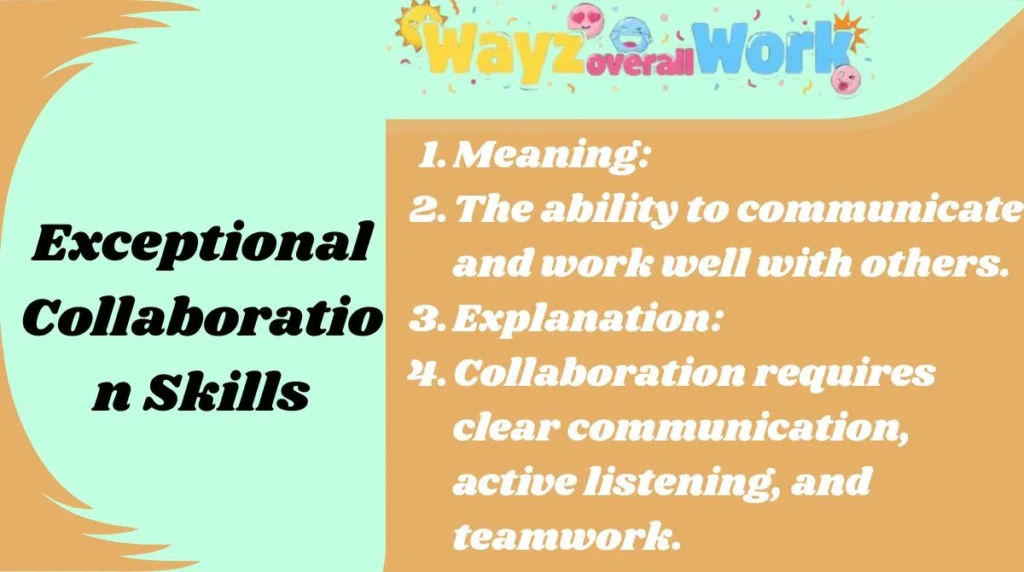
Meaning:
The ability to communicate and work well with others.
Explanation:
Collaboration requires clear communication, active listening, and teamwork. This phrase is popular in job descriptions and performance evaluations.
Grammar Note:
Noun phrase.
Example Sentence:
Her exceptional collaboration skills helped the team complete the project early.
Best Use:
Workplace, Team Projects, Resume
Worst Use:
When describing individual public speaking ability.
Tone:
Professional
Level:
Intermediate
Similarity Score (0–10):
7.5/10
Replaceability Tip:
Use this when teamwork is the main focus.
Outstanding Conversational Skills
Meaning:
The ability to hold engaging and natural conversations.
Explanation:
This phrase is often used to describe friendly people who make conversations enjoyable and meaningful.
Grammar Note:
Noun phrase.
Example Sentence:
He has outstanding conversational skills and makes every guest feel welcome.
Best Use:
Networking, Hospitality, Customer Service
Worst Use:
Formal academic writing.
Tone:
Friendly
Level:
Intermediate
Similarity Score (0–10):
8/10
Replaceability Tip:
Use this when describing everyday conversations instead of business communication.
Excellent Public Speaking Skills
Meaning:
The ability to speak confidently before an audience.
Explanation:
Public speaking is a specialized communication skill. It includes confidence, organization, and audience engagement.
Grammar Note:
Noun phrase.
Example Sentence:
The CEO is known for his excellent public speaking skills.
Best Use:
Leadership, Conferences, Education
Worst Use:
One-on-one conversations.
Tone:
Professional
Level:
Intermediate
Similarity Score (0–10):
7.5/10
Replaceability Tip:
Use this when discussing speeches or presentations rather than everyday communication.
Mini Dialogue Examples
Formal Conversation
Manager: We are looking for someone with excellent interpersonal skills.
HR Manager: I agree. Her references describe her as an effective communicator who works well with every department.
Informal Conversation
Ali: Why does everyone enjoy working with Sara?
Ahmed: She’s great at talking to people. She explains everything clearly and always listens.
Business Email Example
Subject: Performance Feedback
Dear Emma,
Your clear communication and excellent interpersonal skills have greatly improved collaboration within the team. We appreciate your professionalism and your ability to explain complex ideas in a simple way.
Kind regards,
David Wilson
Mistakes to Avoid
- Saying good communication instead of good communication skills when referring to a person’s ability.
- Using articulate speaker for someone who only writes well.
- Confusing people skills with technical skills.
- Using persuasive communicator when no persuasion is involved.
- Repeating good communication skills many times in the same paragraph.
- Using very informal expressions like great at chatting on a professional resume.
- Choosing advanced alternatives without understanding their specific meaning.
Cultural & Tone Tips
Native English speakers usually understand good communication skills as a positive and professional quality. However, choosing a more specific alternative often sounds stronger and more natural.
UK English
British English commonly uses expressions such as excellent interpersonal skills, clear communicator, and good people skills in job advertisements and professional conversations.
US English
American English often prefers phrases like effective communicator, strong communication skills, and excellent verbal communication skills. These are common in resumes, LinkedIn profiles, and interviews.
Casual Social English
Friends rarely say good communication skills in everyday conversation. Instead, they might say:
- Great at talking to people
- Easy to talk to
- Explains things really well
- A good listener
These sound warmer and more natural in informal settings.
Comparison Table
| Phrase | Tone | Best Context | Professional Level | Example |
|---|---|---|---|---|
| Effective communicator | Professional | Resume, Interview | Very High | She is an effective communicator. |
| Excellent interpersonal skills | Formal | Workplace | Very High | He has excellent interpersonal skills. |
| Clear communicator | Neutral | Business, Education | High | She is a clear communicator. |
| Strong verbal communication skills | Formal | Interviews | High | Candidates need strong verbal communication skills. |
| Articulate speaker | Professional | Public Speaking | High | He is an articulate speaker. |
| Strong people skills | Friendly | Customer Service | Medium | She has strong people skills. |
| Able to express ideas clearly | Neutral | Academic, Workplace | High | He can express ideas clearly. |
FAQs
Is good communication skills rude?
No. It is polite, respectful, and suitable for almost every situation.
Is it okay to use it in emails?
Yes. It is commonly used in professional emails and workplace communication.
What is the most formal alternative?
Excellent interpersonal skills and effective communicator are among the most formal choices.
What is the most polite alternative?
Clear communicator is polite, positive, and appropriate in nearly every context.
What should beginners use?
Beginners can confidently use good communication skills, clear communicator, and able to express ideas clearly.
Which alternative is best for a resume?
Effective communicator is one of the strongest and most professional resume phrases.
Conclusion
Using different ways to say good communication skills helps you sound more fluent, confident, and professional. Each alternative has its own tone and purpose.
Some are better for resumes and business meetings, while others work well in everyday conversations. Choosing the right phrase shows that you understand both English vocabulary and context.
As you continue learning English, practice these expressions in emails, interviews, presentations, and daily conversations. The more you use them naturally, the stronger and more effective your communication will become.

Rashmeer is a passionate writer and content creator dedicated to delivering clear, engaging, and reliable information. With a focus on quality and authenticity, Rashmeer creates content that informs, inspires, and helps readers discover practical ideas and fresh perspectives.