
The phrase “for the first time” is one of the most common expressions in English. People use it when they talk about a new experience, a first event, or something that has never happened before.
While it is simple and correct, repeating the same phrase too often can make your writing and speaking sound repetitive.
Learning different ways to say “for the first time” helps you sound more natural and confident. The right alternative can make your emails more professional, your essays more engaging, your business communication clearer, and your conversations more fluent.
For example:
- Formal: The company launched its product for the inaugural time.
- Informal: I tried sushi for the first time ever.
Choosing the right expression depends on your audience, purpose, and the tone you want to create.
What Does “For the First Time” Mean?
“For the first time” means that something is happening, being experienced, or being done on one occasion only before any previous experience. It describes a completely new event or experience.
Grammar Form:
Adverbial phrase
Similar Expressions
- For the first occasion
- Initially
- At the outset
- On the first attempt
- For the inaugural time
Opposite Ideas
- Again
- Once more
- Repeatedly
- As usual
- Another time
Examples
- She drove a car for the first time yesterday.
- Our team met the client for the first time during the conference.
When to Use “For the First Time”
Spoken English
This phrase is perfect for everyday conversations when talking about new experiences.
Example:
I flew alone for the first time last year.
Business English
Use it when introducing new projects, services, partnerships, or achievements.
Example:
Our company entered the European market for the first time.
Emails and Messages
It works well in both formal and friendly emails.
Example:
I am contacting you for the first time regarding your inquiry.
Social Media
People often use it when sharing exciting personal milestones.
Example:
Tried skydiving for the first time today!
Academic Writing
Students can use it when discussing research findings or historical events.
Example:
The species was identified for the first time in 2024.
Professional Meetings
Suitable when presenting new initiatives or updates.
Example:
We are introducing this process for the first time across all departments.
Is “For the First Time” Polite or Professional?
The phrase is both polite and professional. However, different alternatives create different impressions.
| Tone | Description |
|---|---|
| Polite | Safe for almost every situation |
| Neutral | Common in everyday English |
| Soft | Friendly and conversational |
| Strong | Adds emphasis to a major milestone |
| Formal | Excellent for reports and presentations |
| Informal | Better for casual conversations |
Etiquette Tip
- Excellent for workplace communication.
- Suitable for business emails.
- No need to replace it unless you want more variety or a stronger tone.
Pros & Cons of Using “For the First Time”
✔ Pros
- Easy to understand.
- Natural in every English variety.
- Suitable for business writing.
- Works in academic papers.
- Common in daily conversations.
- Beginner-friendly.
✘ Cons
- Can become repetitive.
- Sometimes lacks style.
- May sound plain in creative writing.
- Doesn’t always emphasize importance.
- Stronger alternatives may fit formal reports better.
Quick Alternatives List
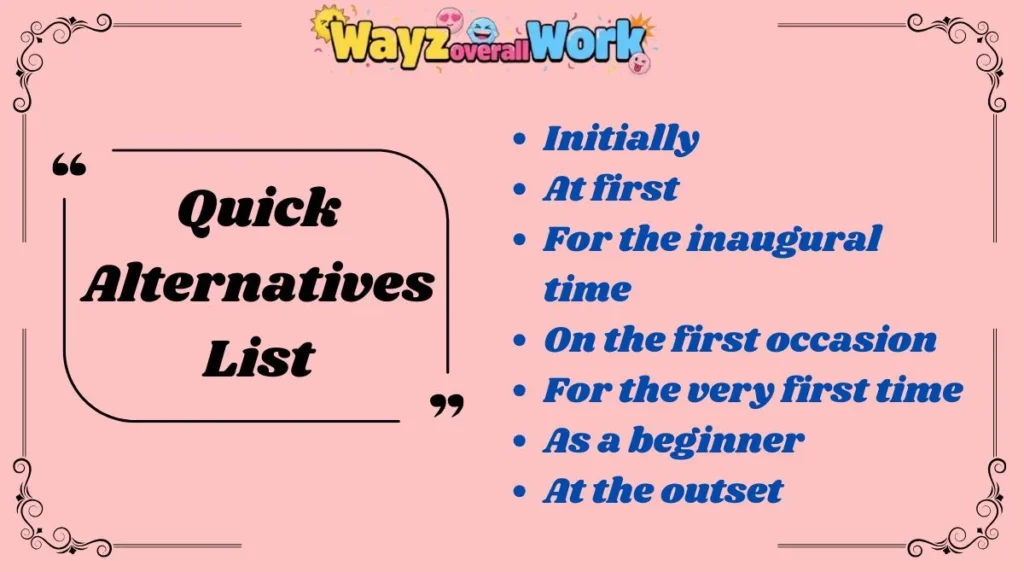
- Initially
- At first
- For the inaugural time
- On the first occasion
- For the very first time
- As a beginner
- At the outset
- On the first attempt
- In its debut
- During the initial stage
- In the beginning
- Upon first experience
- At the start
- Making a debut
- Newly introduced
- First-ever
- Originally
- On debut
Initially
Meaning:
At the beginning of something.
Explanation:
“Initially” is a formal alternative that focuses on the starting stage rather than the entire first experience.
Grammar Note:
Adverb
Example Sentence:
Initially, the project faced several challenges.
Best Use:
Academic writing, reports, workplace
Worst Use:
Talking about exciting personal experiences.
Tone:
Formal
Level:
Intermediate
Similarity Score:
8/10
Replaceability Tip:
Choose it when discussing processes or timelines.
At First
Meaning:
In the beginning.
Explanation:
A simple everyday alternative often used before explaining how something changed later.
Grammar Note:
Adverbial phrase
Example Sentence:
At first, I didn’t enjoy public speaking.
Best Use:
Conversation, stories
Worst Use:
Formal reports requiring precision.
Tone:
Friendly
Level:
Beginner
Similarity Score:
7/10
Replaceability Tip:
Ideal when comparing past and present opinions.
For the Very First Time
Meaning:
The absolute first occasion.
Explanation:
Adds extra excitement and emphasis.
Grammar Note:
Adverbial phrase
Example Sentence:
She performed on stage for the very first time.
Best Use:
Stories, speeches, social media
Worst Use:
Repeated use in formal reports.
Tone:
Emotional
Level:
Beginner
Similarity Score:
10/10
Replaceability Tip:
Use when celebrating an important milestone.
For the Inaugural Time
Meaning:
During the first official occurrence.
Explanation:
Often used for events, ceremonies, and official launches.
Grammar Note:
Formal phrase
Example Sentence:
The conference was held for the inaugural time in Dubai.
Best Use:
Business, government, news
Worst Use:
Casual conversations.
Tone:
Professional
Level:
Advanced
Similarity Score:
9/10
Replaceability Tip:
Excellent for official announcements.
On the First Occasion
Meaning:
During the first event.
Explanation:
A polished phrase commonly found in formal writing.
Grammar Note:
Prepositional phrase
Example Sentence:
On the first occasion, attendance exceeded expectations.
Best Use:
Academic and business writing
Worst Use:
Text messages.
Tone:
Formal
Level:
Advanced
Similarity Score:
8/10
Replaceability Tip:
Works well in reports and presentations.
At the Outset
Meaning:
At the beginning.
Explanation:
A professional phrase often used in reports and speeches.
Grammar Note:
Formal expression
Example Sentence:
At the outset, our objectives were clearly defined.
Best Use:
Professional documents
Worst Use:
Casual chatting.
Tone:
Professional
Level:
Advanced
Similarity Score:
7/10
Replaceability Tip:
Perfect for introductions.
On the First Attempt
Meaning:
Succeeded during the first try.
Explanation:
Focuses on achievement rather than experience.
Grammar Note:
Prepositional phrase
Example Sentence:
She passed the exam on the first attempt.
Best Use:
Education, workplace
Worst Use:
General first experiences.
Tone:
Neutral
Level:
Intermediate
Similarity Score:
6/10
Replaceability Tip:
Use when discussing success.
First-Ever
Meaning:
Never happened before.
Explanation:
A powerful expression for historic events.
Grammar Note:
Compound adjective
Example Sentence:
The city hosted its first-ever robotics festival.
Best Use:
News, marketing
Worst Use:
Everyday conversations.
Tone:
Strong
Level:
Intermediate
Similarity Score:
8/10
Replaceability Tip:
Great for headlines.
Making a Debut
Meaning:
Appearing publicly for the first time.
Explanation:
Common in entertainment, sports, and business.
Grammar Note:
Verb phrase
Example Sentence:
The singer is making her debut tonight.
Best Use:
Media, entertainment
Worst Use:
Academic essays.
Tone:
Professional
Level:
Intermediate
Similarity Score:
7/10
Replaceability Tip:
Use for first public appearances.
In the Beginning
Meaning:
At the start.
Explanation:
Simple and natural.
Grammar Note:
Prepositional phrase
Example Sentence:
In the beginning, the software had several bugs.
Best Use:
Stories
Worst Use:
Formal business reports.
Tone:
Neutral
Level:
Beginner
Similarity Score:
7/10
Replaceability Tip:
Useful in narratives.
Originally
Meaning:
At the earliest stage.
Explanation:
Describes original plans or conditions.
Grammar Note:
Adverb
Example Sentence:
Originally, the office was located downtown.
Best Use:
Business, history
Worst Use:
Personal first experiences.
Tone:
Formal
Level:
Intermediate
Similarity Score:
5/10
Replaceability Tip:
Use for discussing original ideas.
Upon First Experience
Meaning:
When experiencing something initially.
Explanation:
A formal expression found in academic writing.
Grammar Note:
Formal phrase
Example Sentence:
Upon first experience, users found the software intuitive.
Best Use:
Research
Worst Use:
Casual conversation.
Tone:
Formal
Level:
Advanced
Similarity Score:
8/10
Replaceability Tip:
Useful for user studies.
Newly Introduced
Meaning:
Recently presented for the first time.
Explanation:
Highlights something that has just appeared.
Grammar Note:
Adjective phrase
Example Sentence:
The newly introduced policy improves efficiency.
Best Use:
Business
Worst Use:
Personal stories.
Tone:
Professional
Level:
Intermediate
Similarity Score:
6/10
Replaceability Tip:
Perfect for workplace announcements.
On Debut
Meaning:
During the first public appearance.
Explanation:
Frequently used in sports and entertainment.
Grammar Note:
Phrase
Example Sentence:
The player scored on debut.
Best Use:
Sports journalism
Worst Use:
Academic writing.
Tone:
Professional
Level:
Advanced
Similarity Score:
6/10
Replaceability Tip:
Ideal for media reports.
As a Beginner
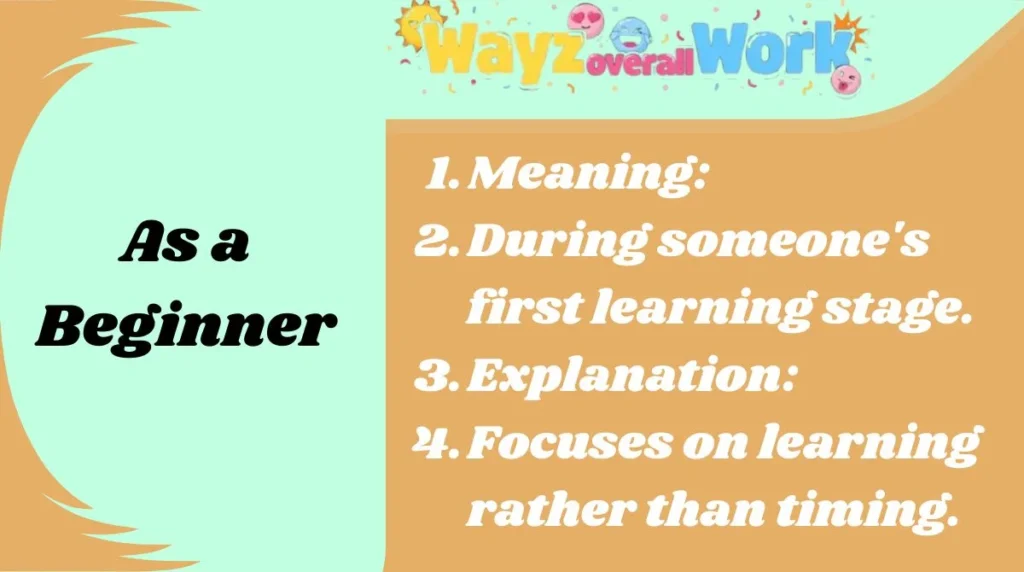
Meaning:
During someone’s first learning stage.
Explanation:
Focuses on learning rather than timing.
Grammar Note:
Phrase
Example Sentence:
As a beginner, I practiced every day.
Best Use:
Education
Worst Use:
Historical writing.
Tone:
Friendly
Level:
Beginner
Similarity Score:
5/10
Replaceability Tip:
Useful for skill development.
At the Start
Meaning:
At the beginning.
Explanation:
A straightforward alternative for everyday English.
Grammar Note:
Phrase
Example Sentence:
At the start, everyone felt nervous.
Best Use:
General English
Worst Use:
Historic milestones.
Tone:
Neutral
Level:
Beginner
Similarity Score:
7/10
Replaceability Tip:
Simple and natural.
For the First Occasion
Meaning:
On the initial event.
Explanation:
A formal but less common variation.
Grammar Note:
Phrase
Example Sentence:
The award was presented for the first occasion in 2025.
Best Use:
Formal writing
Worst Use:
Daily conversation.
Tone:
Formal
Level:
Advanced
Similarity Score:
8/10
Replaceability Tip:
Reserve for official contexts.
Mini Dialogue Examples
Formal Conversation
Manager: Have we worked with this client before?
Employee: No. We are meeting them for the first time this afternoon.
Informal Conversation
Alex: Have you tried Korean food?
Ben: Yes! I had it for the very first time last weekend.
Business Email
Dear Ms. Carter,
We are pleased to collaborate with your organization for the inaugural time. We look forward to building a successful partnership.
Kind regards,
David
Mistakes to Avoid
- Using initially when talking about a single exciting experience.
- Saying firstly time instead of for the first time.
- Using debut for ordinary daily activities.
- Repeating for the first time many times in one paragraph.
- Choosing very formal alternatives in casual conversations.
- Mixing at first with events that happened only once.
- Using first-ever for small personal experiences where it sounds exaggerated.
Cultural & Tone Tips
In US English, for the first time is common in both professional and casual settings.
In UK English, speakers also use it naturally, although formal writing often prefers expressions like initially or at the outset.
In casual social English, people frequently say for the very first time, first-ever, or simply my first time because these sound more enthusiastic and conversational.
Comparison Table
| Phrase | Tone | Best Context | Professional Level | Example |
|---|---|---|---|---|
| For the very first time | Friendly | Conversation | Medium | I traveled abroad for the very first time. |
| Initially | Formal | Reports | High | Initially, sales were low. |
| At first | Casual | Stories | Medium | At first, I was nervous. |
| At the outset | Professional | Meetings | High | At the outset, goals were explained. |
| First-ever | Strong | News | High | The city hosted its first-ever marathon. |
| Making a debut | Professional | Entertainment | High | The actor is making his debut. |
| On the first attempt | Neutral | Education | Medium | She passed on the first attempt. |
Frequently Asked Questions
Is “for the first time” rude?
No. It is polite and natural.
Is it okay in business emails?
Yes. It is professional and widely accepted.
What is the most formal alternative?
At the outset and for the inaugural time are among the most formal choices.
What is the most polite alternative?
Initially is polite and professional.
Which alternative is easiest for beginners?
At first is the easiest.
Which expression sounds the most natural?
For the very first time is one of the most natural choices in everyday conversation.
Conclusion
Using different ways to say “for the first time” makes your English richer, clearer, and more engaging.
While the original phrase works well in almost every situation, choosing an alternative that matches the context helps you communicate more naturally.
Professional writing often benefits from expressions like initially or at the outset, while everyday conversations sound smoother with phrases such as at first or for the very first time.
The more alternatives you learn and practice, the easier it becomes to speak and write with confidence. Try using these expressions in conversations, emails, presentations, and essays to build stronger English skills.

Rashmeer is a passionate writer and content creator dedicated to delivering clear, engaging, and reliable information. With a focus on quality and authenticity, Rashmeer creates content that informs, inspires, and helps readers discover practical ideas and fresh perspectives.