
The phrase “please advise” is common in business emails, workplace messages, and professional communication. People use it when they want someone to provide guidance, instructions, or a decision.
It is short and direct, but because it appears so often, it can sometimes sound repetitive, cold, or overly formal.
Learning different ways to say “please advise” helps you communicate more naturally. The right wording can make your message sound more polite, professional, friendly, or confident depending on the situation.
This is especially useful in emails, meetings, customer service, academic writing, and everyday conversations.
For example:
Formal: Please advise on the next steps.
Informal: Let me know what you think.
Small changes like these make your English sound smoother and more natural while matching the tone of your audience.
What Does “Please Advise” Mean?
Please advise means “please tell me what I should do,” “please give me guidance,” or “please provide your opinion or instructions.”
It is a formal verb phrase. The word advise is a verb that means to give advice, guidance, or recommendations.
Similar expressions include:
- Please let me know
- Could you advise me?
- I would appreciate your guidance
- Please share your thoughts
- Please provide your feedback
Expressions with the opposite tone include:
- Don’t worry about it.
- No advice needed.
- I’ve already decided.
Examples:
- Please advise on the delivery schedule.
- Please advise whether we should continue with the project.
When to Use “Please Advise”
Spoken English
People rarely say please advise in everyday conversations. Instead, they usually choose friendlier expressions such as What do you think? or Can you help me decide?
Business English
This phrase works well when asking managers, clients, supervisors, or colleagues for guidance. It is common in reports, project updates, and formal workplace communication.
Emails and Messages
It is widely used in professional emails when requesting instructions or clarification. However, using the same phrase repeatedly can make your writing sound mechanical.
Social Media
The phrase sounds too formal for most social media conversations. Casual alternatives feel more natural.
Academic Writing
Students may use it when emailing professors or requesting academic guidance, although more polite alternatives often sound better.
Professional Meetings
During meetings, people usually say Could you share your recommendation? or What would you suggest? instead of simply saying please advise.
Is “Please Advise” Polite or Professional?
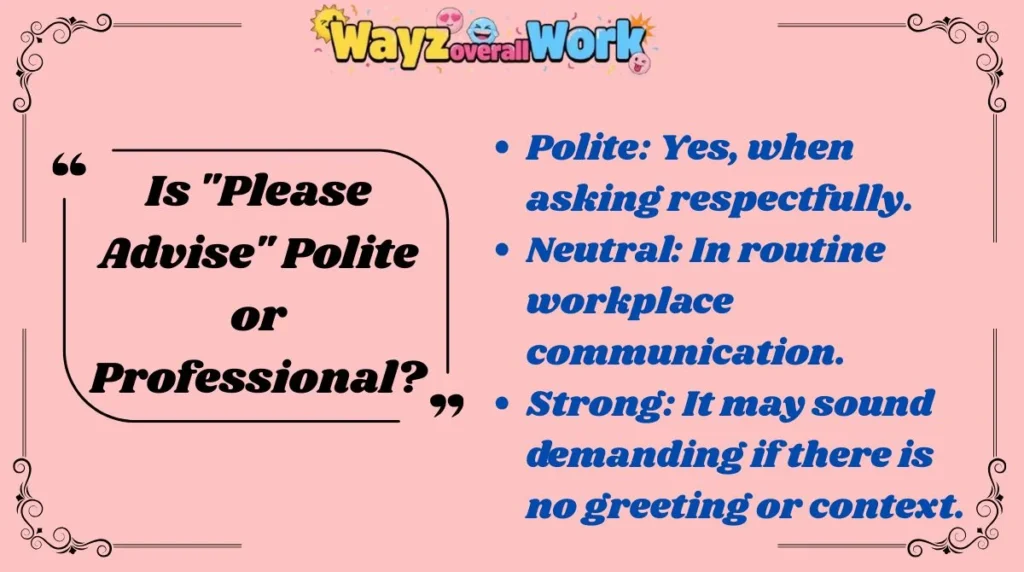
Please advise is generally considered both polite and professional.
Its tone depends on the situation.
- Polite: Yes, when asking respectfully.
- Neutral: In routine workplace communication.
- Strong: It may sound demanding if there is no greeting or context.
- Soft: Adding words like when convenient or if possible softens the request.
- Formal: Very common in business communication.
- Informal: Rarely used among close friends.
Etiquette Tip: It is suitable for workplace communication, but avoid overusing it in corporate emails. Using warmer alternatives often creates a friendlier impression.
Pros & Cons of Using “Please Advise”
✔ Pros
- Professional and widely understood.
- Short and direct.
- Suitable for business emails.
- Requests guidance clearly.
- Works well in formal communication.
✘ Cons
- Can sound cold or impersonal.
- Repeated use feels robotic.
- Too formal for casual conversations.
- May sound demanding without context.
- Native speakers often prefer softer alternatives.
Quick Alternatives List
- Please let me know
- Could you advise me?
- I would appreciate your guidance
- Please share your thoughts
- What would you recommend?
- Could you clarify?
- Please provide your feedback
- I’d appreciate your input
- Can you help me with this?
- What do you think?
- Please confirm
- Please review and respond
- Could you point me in the right direction?
- May I have your opinion?
- Please suggest the next steps
- Kindly let me know
- I’d value your advice
- Could you guide me?
- Please tell me how to proceed
Please Let Me Know
Meaning: Ask someone to give you information.
Explanation: This is the most common replacement. It sounds friendly, natural, and works in almost every situation.
Grammar Note: Polite verb phrase.
Example Sentence: Please let me know if you have any questions.
Best Use: Email, workplace, everyday conversation.
Worst Use: Situations requiring legal or technical advice.
Tone: Neutral, Professional.
Level: Beginner.
Similarity Score: 10/10.
Replaceability Tip: Use it when you simply need information rather than detailed advice.
Could You Advise Me?
Meaning: Ask someone for advice.
Explanation: More polite and conversational than please advise.
Grammar Note: Question form.
Example Sentence: Could you advise me on the best option?
Best Use: Formal emails.
Worst Use: Casual texting.
Tone: Formal.
Level: Intermediate.
Similarity Score: 10/10.
Replaceability Tip: Perfect when directly requesting guidance.
I Would Appreciate Your Guidance
Meaning: Ask for expert help.
Explanation: Shows respect and appreciation. It is excellent when speaking with senior professionals.
Grammar Note: Formal expression.
Example Sentence: I would appreciate your guidance on this matter.
Best Use: Workplace, academic emails.
Worst Use: Informal chats.
Tone: Very Professional.
Level: Advanced.
Similarity Score: 9.5/10.
Replaceability Tip: Use when communicating with managers or professors.
Please Share Your Thoughts
Meaning: Ask for someone’s opinion.
Explanation: Invites discussion rather than instructions.
Grammar Note: Verb phrase.
Example Sentence: Please share your thoughts before Friday.
Best Use: Team discussions.
Worst Use: Emergency situations.
Tone: Friendly Professional.
Level: Beginner.
Similarity Score: 8/10.
Replaceability Tip: Best when collaboration is important.
What Would You Recommend?
Meaning: Ask for a recommendation.
Explanation: Focuses on suggestions instead of orders.
Grammar Note: Question.
Example Sentence: What would you recommend for this project?
Best Use: Business meetings.
Worst Use: When only factual information is needed.
Tone: Polite.
Level: Intermediate.
Similarity Score: 9/10.
Replaceability Tip: Great when multiple options exist.
Could You Clarify?
Meaning: Ask someone to explain.
Explanation: Useful when information is unclear.
Grammar Note: Question.
Example Sentence: Could you clarify the deadline?
Best Use: Emails and meetings.
Worst Use: Requesting general advice.
Tone: Neutral.
Level: Beginner.
Similarity Score: 7/10.
Replaceability Tip: Use when confusion is the main issue.
Please Provide Your Feedback
Meaning: Ask for comments or opinions.
Explanation: Often used after sharing work or ideas.
Grammar Note: Formal phrase.
Example Sentence: Please provide your feedback on the proposal.
Best Use: Workplace.
Worst Use: Personal conversations.
Tone: Professional.
Level: Intermediate.
Similarity Score: 8/10.
Replaceability Tip: Better when reviewing documents or projects.
I’d Appreciate Your Input
Meaning: Ask someone to contribute ideas.
Explanation: Sounds collaborative and respectful.
Grammar Note: Polite phrase.
Example Sentence: I’d appreciate your input before we finalize the report.
Best Use: Team projects.
Worst Use: Urgent decisions.
Tone: Friendly Professional.
Level: Intermediate.
Similarity Score: 8.5/10.
Replaceability Tip: Excellent for teamwork.
Can You Help Me With This?
Meaning: Request assistance.
Explanation: Simple and friendly.
Grammar Note: Question.
Example Sentence: Can you help me with this report?
Best Use: Casual workplace conversations.
Worst Use: Executive emails.
Tone: Friendly.
Level: Beginner.
Similarity Score: 7/10.
Replaceability Tip: Good for everyday communication.
What Do You Think?
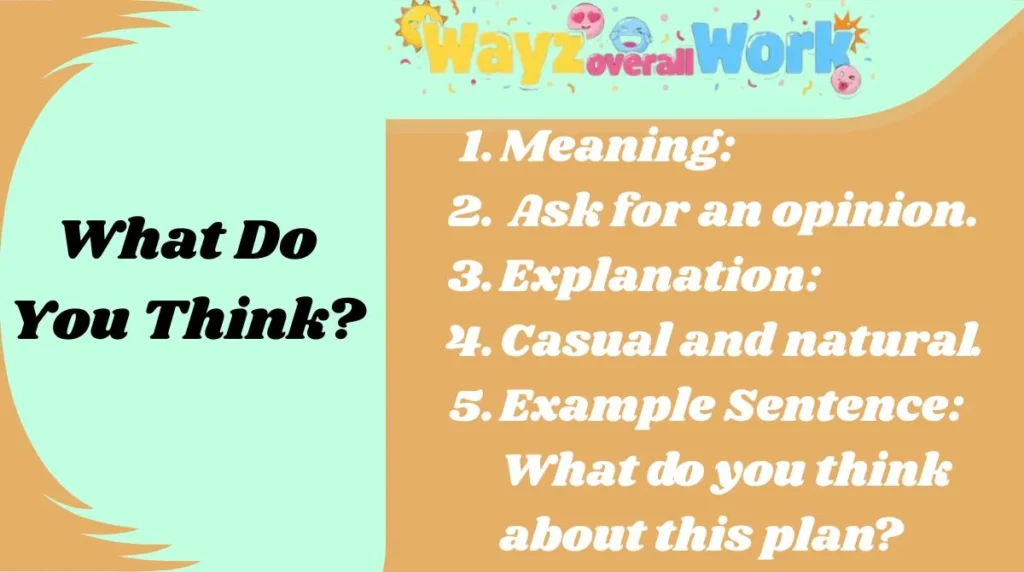
Meaning: Ask for an opinion.
Explanation: Casual and natural.
Grammar Note: Question.
Example Sentence: What do you think about this plan?
Best Use: Friends and colleagues.
Worst Use: Formal legal correspondence.
Tone: Informal.
Level: Beginner.
Similarity Score: 7/10.
Replaceability Tip: Perfect for brainstorming.
Please Confirm
Meaning: Ask someone to verify information.
Explanation: Requests confirmation rather than advice.
Grammar Note: Verb phrase.
Example Sentence: Please confirm your attendance.
Best Use: Business emails.
Worst Use: Asking for recommendations.
Tone: Professional.
Level: Beginner.
Similarity Score: 6/10.
Replaceability Tip: Use when you only need verification.
Please Review and Respond
Meaning: Ask someone to examine something before replying.
Explanation: Common in project management.
Grammar Note: Formal instruction.
Example Sentence: Please review the attached document and respond.
Best Use: Workplace.
Worst Use: Friendly chats.
Tone: Professional.
Level: Intermediate.
Similarity Score: 7/10.
Replaceability Tip: Ideal for reports and proposals.
Could You Point Me in the Right Direction?
Meaning: Ask for guidance.
Explanation: Friendly and conversational.
Grammar Note: Idiomatic phrase.
Example Sentence: Could you point me in the right direction?
Best Use: Conversations.
Worst Use: Formal legal writing.
Tone: Friendly.
Level: Intermediate.
Similarity Score: 8/10.
Replaceability Tip: Good when you only need initial guidance.
May I Have Your Opinion?
Meaning: Ask for someone’s viewpoint.
Explanation: Respectful and courteous.
Grammar Note: Formal question.
Example Sentence: May I have your opinion on this proposal?
Best Use: Academic and professional settings.
Worst Use: Urgent requests.
Tone: Formal.
Level: Intermediate.
Similarity Score: 8/10.
Replaceability Tip: Best when seeking thoughtful feedback.
I’d Value Your Advice
Meaning: Show respect for someone’s expertise.
Explanation: Expresses appreciation while requesting guidance.
Grammar Note: Polite phrase.
Example Sentence: I’d value your advice before making a decision.
Best Use: Professional relationships.
Worst Use: Casual texting.
Tone: Professional.
Level: Advanced.
Similarity Score: 9/10.
Replaceability Tip: Excellent when addressing experienced people.
Please Tell Me How to Proceed
Meaning: Ask for the next steps.
Explanation: Very clear and action-focused.
Grammar Note: Formal phrase.
Example Sentence: Please tell me how to proceed with the application.
Best Use: Business emails.
Worst Use: Casual conversations.
Tone: Professional.
Level: Intermediate.
Similarity Score: 10/10.
Replaceability Tip: Choose this when you specifically need instructions.
Mini Dialogue Examples
Formal Conversation
Employee: The client requested changes to the contract.
Manager: I understand.
Employee: Could you advise me on the next steps?
Manager: Yes. Update the document and send it back for approval.
Informal Conversation
Alex: I’m not sure which laptop to buy.
Sam: What’s your budget?
Alex: What would you recommend?
Business Email Example
Subject: Project Timeline
Hello Sarah,
The supplier has delayed the shipment by three days.
Please let me know how you would like us to proceed.
Thank you.
Best regards,
Daniel
Mistakes to Avoid
- Using please advise in casual conversations with friends.
- Writing only Please advise. without explaining the situation.
- Confusing advise (verb) with advice (noun).
- Using overly formal language in text messages.
- Repeating the same phrase in every email.
- Asking for advice when you actually need confirmation.
- Forgetting to include context before requesting guidance.
Cultural & Tone Tips
In US English, native speakers often prefer warmer alternatives such as Please let me know or I’d appreciate your input because they sound more conversational.
In UK English, please advise is understood and acceptable, especially in business settings, but softer wording is also becoming more common.
In casual social English, people almost never say please advise. Instead, they choose natural expressions like What do you think?, Can you help me?, or Let me know.
Comparison Table
| Phrase | Tone | Best Context | Professional Level | Example |
|---|---|---|---|---|
| Please let me know | Neutral | Emails | High | Please let me know your decision. |
| Could you advise me? | Formal | Workplace | Very High | Could you advise me on this issue? |
| I’d appreciate your guidance | Professional | Managers | Very High | I’d appreciate your guidance. |
| Please share your thoughts | Friendly | Teamwork | High | Please share your thoughts on the plan. |
| What would you recommend? | Polite | Meetings | High | What would you recommend? |
| I’d value your advice | Respectful | Professional | Very High | I’d value your advice before deciding. |
| Please tell me how to proceed | Formal | Business emails | Very High | Please tell me how to proceed. |
FAQ
Is “please advise” rude?
No. It is generally polite, but it can sound too direct if used without context.
Is it okay in emails?
Yes. It is common in professional emails.
What is the most formal alternative?
I would appreciate your guidance is one of the most formal options.
What is the most polite alternative?
I’d value your advice is respectful and courteous.
What should beginners use?
Please let me know is the easiest and most natural choice.
Which alternative sounds the most natural?
Please let me know is the expression native speakers use most often in everyday professional communication.
Conclusion
Using different ways to say “please advise” makes your English clearer, friendlier, and more professional.
While the original phrase is useful in business communication, repeating it too often can make your writing sound stiff.
Learning alternatives like Please let me know, I’d appreciate your guidance, and What would you recommend? allows you to match your words to different situations and audiences.
Whether you are writing an email, speaking in a meeting, or asking for help in everyday life, choosing the right expression will improve your confidence and communication skills.
Practice these alternatives regularly, and they will soon become a natural part of your English.

Rashmeer is a passionate writer and content creator dedicated to delivering clear, engaging, and reliable information. With a focus on quality and authenticity, Rashmeer creates content that informs, inspires, and helps readers discover practical ideas and fresh perspectives.